
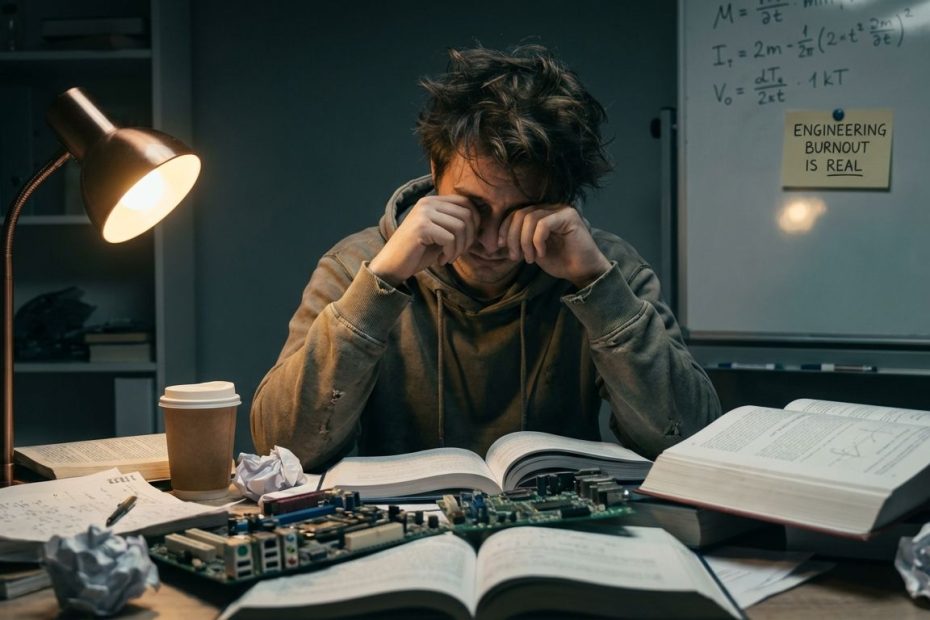
Burnout in engineering programs is real, common, and often predictable. You’re not “weak” or “not cut out for it” because you feel wiped out, detached, or stuck, you’re responding to a workload system that often runs hot for months at a time.
This article gives you a field-tested way to spot burnout early, separate normal pressure from a real slide, and make practical moves that protect grades, health, and long-term career momentum. You’ll leave with clear decision triggers, workload tactics, and program-navigation moves that engineering students rarely get taught, yet working engineers use constantly.
What Does Burnout Look Like In Engineering Students (And How Is It Different From “Normal” Stress)?
Normal engineering stress is time-bound. It spikes around exams, lab demos, project milestones, then eases when the deadline clears. You might feel tired, you might complain, you might sleep less for a week, then you rebound when the calendar opens up.
Burnout behaves differently. It shows up as persistent exhaustion that sleep doesn’t fix, growing cynicism or detachment from classes, and a rising sense that effort no longer produces results. Those markers line up with how academic burnout is typically characterized in higher-ed research: fatigue, disengagement, and reduced sense of accomplishment. You’ll notice the shift when you can’t start tasks you already know how to do, or when you keep staring at work you used to handle and your brain refuses to engage.
Engineering makes this harder to spot because the culture often treats constant strain as normal. Many programs implicitly reward endurance, not recovery. In qualitative research on engineering culture and student mental health, students describe heavy workload as a defining stressor, lean heavily on peers to cope, and cite barriers to seeking help like time pressure, stigma, and fear of falling behind.
In real student language, burnout reads like “I’m fried,” “I hit a wall,” “I can’t make myself start,” “I stopped caring,” “I’m skipping class because it feels pointless.” Those are not quirky moods. They’re operational failures: execution stops, then the backlog compounds, then grades drop, then confidence collapses.
One more practical test: stress still lets you care. Burnout often turns caring into numbness. When you notice your motivation shifting from “I want to learn and do well” to “I just need this to end,” treat that as a signal, not a personality trait.
How Common Is Burnout (Or Burnout-Adjacent Mental Health Strain) Among Engineering Students Right Now?
Most campuses do not measure “burnout” with a single standard instrument across majors, so burnout prevalence is harder to compare cleanly than depression or anxiety screening rates. Even with that limitation, multiple large-scale student datasets show mental health strain remains widespread, and engineering subcultures often report high workload pressure and time barriers that raise burnout risk.
One of the biggest U.S. datasets, the Healthy Minds Study reporting highlighted by the University of Michigan School of Public Health, shows that college student depression, anxiety, and suicidal thoughts have declined for a third consecutive year, yet many indicators remain high and loneliness remains common. That matters for engineering students because burnout tends to ride on top of the same conditions: chronic overload, low recovery, and isolation.
Engineering-specific findings also keep showing up in peer-reviewed work on engineering culture. Students describe persistent stress norms and help-seeking friction: you have limited time, you fear slipping behind, and you often rely on peer networks more than formal supports. That combination drives a predictable pattern: students wait too long, then reach for fixes only after performance has already dipped.
Day-to-day reality confirms it. Student communities repeatedly surface the same stories: second-year workload ramps up, labs stack with math and theory courses, one bad week becomes a month, and the program’s prerequisite chain turns a temporary dip into a delayed graduation threat. When students talk about “burnout,” they often mean a blend of exhaustion, anxiety about falling behind, and a feeling of being trapped by the curriculum’s sequencing.
Why Do Engineering Programs Cause Burnout So Often (Is It Really Just “Engineering Is Hard”)?
Yes, engineering content is hard. That’s not the main problem. The bigger driver is how work arrives: dense prerequisites, multiple concurrent deliverables, and repeated high-stakes evaluation stacked across the same weeks. When four courses all run “peak workload mode” simultaneously, your schedule stops being a schedule and turns into a collision.
Accreditation expectations also shape this reality. ABET criteria require substantial coverage of math and basic sciences, engineering topics, and a culminating design experience, plus program systems for advising and monitoring progress. Programs often respond by packing required courses tightly, leaving less room to spread load or recover when life happens. Even when faculty want to help, the degree map often has little slack.
Recent curriculum-structure research goes further: “hardness” can be a property of the curriculum graph itself. If the longest prerequisite path is long and the bottlenecks are severe, a capable student can still get jammed by a single course sequence. That turns one rough term into a cascading delay, which raises stress, which reduces performance, which increases the chance of another delay. The plan becomes a pressure amplifier.
Engineering programs also add unique friction: labs with fixed hours, team projects where your grade depends on coordination, and courses that punish partial understanding. When your calendar has few movable blocks, one missed day triggers a chain reaction. You’re not just “behind,” you’re behind in a way that is hard to repay.
Another overlooked driver is cognitive switching cost. Engineering students often juggle unrelated modes of thinking in the same week: proofs, coding, circuit analysis, lab reports, CAD, and design reviews. That constant switching is mentally expensive. It erodes the “easy momentum” that students rely on to keep output steady.
Is Engineering Burnout “My Fault” (Time Management/Discipline) Or A Program Problem?
Burnout is usually a systems failure with individual knobs you can turn. The program’s structure sets baseline heat: course density, prerequisite rigidity, grading intensity, lab scheduling. Your personal habits then determine whether you can dissipate that heat: sleep, planning, recovery, social support, and whether you ask for help before you’re underwater.
Engineering culture can push you toward the wrong interpretation. When everyone around you acts like suffering is normal, distress feels like personal weakness. Research on engineering student stress culture shows students report workload pressure, time barriers, and norms that can discourage help-seeking. When that’s the environment, self-blame becomes the default, and self-blame delays action.
Here’s the practical truth you can use: discipline helps, but discipline cannot beat physics. If the weekly workload consistently exceeds the hours you can realistically execute at a high level, you cannot “grind” your way out long term. You can push for a week or two. You cannot run that deficit for a semester without paying for it in sleep, mood, focus, or performance.
Time management also isn’t one skill. It breaks into separate competencies: forecasting workload, protecting deep-work blocks, preventing backlog, and resetting quickly after a miss. Many students “plan” but don’t forecast. They fill a calendar without estimating the true time cost of problem sets, debugging, and lab writeups. That mismatch is a fast path to feeling like you’re failing even when you’re working hard.
Use a better standard: if your plan fails every week, it’s not a moral issue. It’s an estimation issue or a load issue. Fix the inputs. Reduce load, change tactics, or change sequencing.
When Should You Take A Break, Drop A Course, Or Rethink Your Plan?
Burnout becomes dangerous academically when execution collapses. If you’re missing classes, skipping labs, unable to start assignments, or repeatedly pulling all-nighters with no payoff, the situation is no longer “a tough week.” It’s a performance breakdown that can turn into a transcript problem.
Use concrete triggers. If symptoms persist for multiple weeks, grades are trending down across more than one course, and recovery actions (sleeping more for a few nights, catching up one subject) don’t restore momentum, you need a structural change. Structural means dropping a course, negotiating accommodations, reducing outside commitments, or planning a leave. Waiting for finals is a gamble, not a plan.
Repeated failure in the same course is another decisive trigger because of prerequisite chains. When a required course blocks multiple future courses, continuing to retake it under the same conditions can lock you into a loop. Students talk about this openly in engineering forums: a second failure feels like a year slipping away, and that pressure alone can keep performance pinned down.
A break does not mean quitting engineering. A leave can be a planned reset that protects long-term completion. The smartest version is scheduled, financed, and aligned with a return path: meet with advising, confirm course availability, map prerequisites, and identify what changes when you return (lighter load, different instructor, tutoring plan, reduced work hours). When breaks are unplanned, students often drift and lose structure. Planned breaks protect structure.
Dropping one course can also be the highest-return move you make. One less lab or one less math-heavy class can restore sleep, restore focus, and turn three “barely passing” courses into three solid grades. That trade is often worth more than the pride of “pushing through.”
What Actually Helps Engineering Burnout (That Isn’t Generic Advice)?
The fixes that work are operational. They change your environment, your schedule mechanics, and your workload profile. Motivational talk doesn’t move the needle when you’re already maxed out; execution design does.
Start with workload triage
List every deliverable for the next 14 days, then rank by grade impact and prerequisite risk. Prioritize items that block other tasks: lab pre-work, coding milestones, and any assignment tied to a locked submission window. You’re not aiming for perfect. You’re aiming to stop the bleeding and prevent compounding backlog.
Build one reliable daily output block
Pick a time window you can defend most days, then assign it to the hardest task of the day, not the easiest. Engineering burnout often worsens when you spend all day “being busy” and never touch the task you fear most. One protected block changes the cycle: hard task moves forward, anxiety drops, then the rest of the day becomes manageable.
Use peer structure, not just peer comfort
Students often say study groups help, and they do, but only when the group creates accountability and reduces friction. Meet in a place that signals work, set a start time, assign each person a target deliverable, then run focused work sprints. Social study without structure becomes another time sink.
Stop re-reading, start producing
Burned-out students often “study” by reading notes repeatedly because it feels safer than solving. Engineering grades reward output: problem solving, derivations, code, lab analysis, design justification. Switch to production-based study: attempt problems first, then consult notes only to fix specific gaps.
Use office hours as a debugging tool
Don’t show up and ask “Can you explain everything?” Bring your attempt, circle where you got stuck, and ask targeted questions. This shortens time-to-clarity, protects your schedule, and shows instructors you’re executing. That often leads to better guidance and, when appropriate, more flexibility.
Adjust course load strategically, not emotionally
If you can’t drop a class this term, reduce friction somewhere else: fewer extracurricular hours, fewer optional projects, fewer “nice-to-have” perfection upgrades on lab reports. Engineering students often burn out chasing polished work when “good and submitted” would preserve health and grade stability.
Technology can help at the margins. Research prototypes are exploring wearable-driven stress monitoring and machine-learning based detection to support real-time stress management in college populations. Treat that as an add-on, not a solution. Burnout prevention is still mostly load management, recovery protection, and early intervention.
Is Burnout Getting Worse Or Better In 2025–2026 (And Why Does It Still Feel Everywhere)?
Broad student mental health indicators reported through the Healthy Minds Study coverage from major universities show improvement trends for depression and anxiety for multiple years running. That’s a positive shift. It does not mean students feel great day-to-day, and it does not remove the structural pressures inside demanding majors.
Two realities can be true at once: fewer students meet clinical screening thresholds, and large numbers of students still feel exhausted, lonely, or stretched. Burnout is also a popular label for many kinds of strain. Students use it as shorthand for overload, lack of motivation, poor sleep, and academic frustration. That makes burnout feel omnipresent even when certain clinical indicators improve.
Engineering intensifies that perception because the pain points are visible and shared. When half your cohort is talking about back-to-back labs, stacked exams, and heavy prerequisite chains, the narrative spreads fast. If you’re already tired, that narrative reinforces the feeling that the only way through is suffering, which increases isolation and delays help-seeking.
There’s also a calendar effect. Many engineering programs synchronize major stress spikes: midterm blocks, design review weeks, lab practicals, and project demos. When the whole department hits peak intensity at the same time, burnout stories cluster. You see them everywhere because everyone is living them at once.
What Is Burnout In Engineering School?
- Persistent exhaustion
- Detachment or cynicism about classes
- Lower performance even with high effort
- Momentum collapse that lasts weeks
Turn This Into A Real Plan This Week
Burnout doesn’t resolve through willpower, it resolves through decisions that reduce load, restore sleep, and rebuild consistent output. Start by auditing the next 14 days, then cut, defer, or renegotiate anything that pushes you past sustainable hours. Protect one daily deep-work block, and use it for the hardest task, because that’s where momentum returns.
Then fix the compounding factors: stop studying in ways that feel productive but don’t create output, stop letting backlog grow silently, and stop waiting for a crisis to ask for help. Use office hours to debug, use peers to create accountability, and use advising to re-sequence courses when bottlenecks threaten your timeline. Engineering rewards steady execution more than heroic bursts, and you can design your week to produce steadiness.
If performance is already slipping across multiple courses, treat that as a signal to change the system now. A reduced course load or a planned break can protect your transcript and your long-term options. The goal isn’t to “power through” at any cost, the goal is to finish the degree with your capability intact and your confidence rebuildable.
References
- Reddit, r/EngineeringStudents, “burnt.” (thread): https://www.reddit.com/r/EngineeringStudents/comments/1ja7q67/burnt/
- BMC Medical Education, “Factors associated with academic burnout and its prevalence among university students: a cross-sectional study”: https://link.springer.com/article/10.1186/s12909-023-04316-y
- International Journal of STEM Education, “Undergraduate student perceptions of stress and mental health in engineering culture”: https://link.springer.com/article/10.1186/s40594-023-00419-6
- University of Michigan School of Public Health, “Healthy Minds Study: College student depression, anxiety decline for third consecutive year”: https://www1.sph.umich.edu/news/2025posts/college-student-mental-health-third-consecutive-year-improvement.html
- UCLA Newsroom, “For third year in a row, college students report lower rates of depression, anxiety and suicidal thoughts”: https://newsroom.ucla.edu/releases/college-students-mental-health-report-ucla
- ABET, “Criteria for Accrediting Engineering Programs, 2026–2027”: https://www.abet.org/accreditation/accreditation-criteria/criteria-for-accrediting-engineering-programs-2026-2027/
- arXiv, “The Topology of Hardship: Empirical Curriculum Graphs and Structural Bottlenecks in Engineering Degrees” (Dec 5, 2025): https://arxiv.org/abs/2512.05561
- arXiv, “Real-Time Stress Monitoring, Detection, and Management in College Students: A Wearable Technology and Machine-Learning Approach”: https://arxiv.org/abs/2505.15974

Chrysilios Chrysiliou is a commercial real estate executive at RDPH Properties, Inc. with a diverse background in aviation and entrepreneurship. A former Greek Air Force Academy graduate, flight instructor, and flight school co-owner, he now leverages decades of strategic leadership to identify and develop high-value real estate opportunities.