
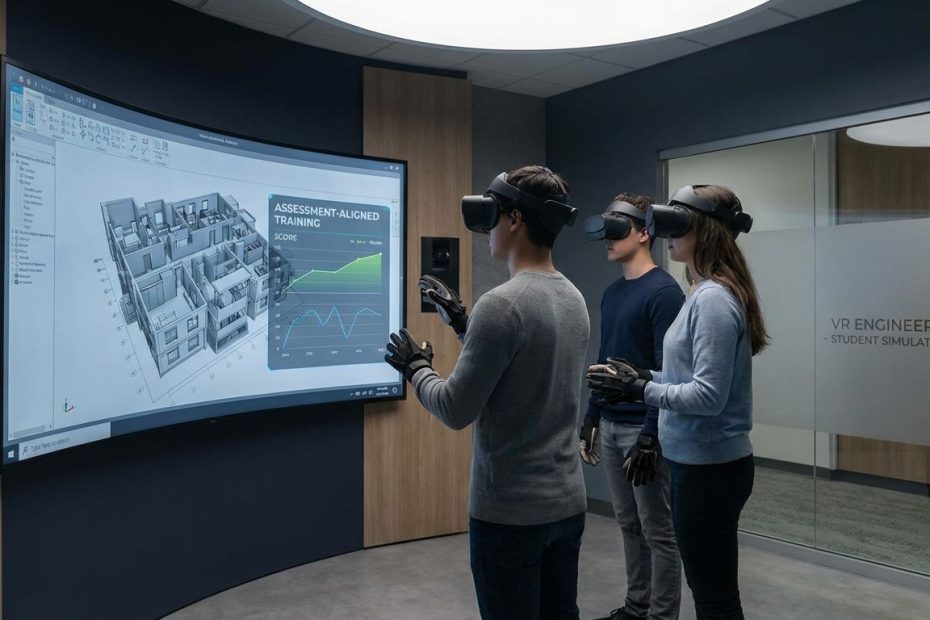
VR lab simulations improve engineering course scores when they are tied to graded outcomes, run with tight instructional design, and used to increase repeatable practice on procedures and spatial concepts. The best results show up when VR supports, not replaces, hands-on labs, and when you measure performance with the same skills students rehearsed in the simulation.
This article breaks down what the evidence says about score gains, where VR works best in engineering, what tends to sabotage results, and how to implement VR labs so you get higher exam and lab-assignment performance, not just higher engagement. Expect practical ranges, design moves that raise grades, and operational guardrails that prevent tech friction from erasing learning time.
Do VR Lab Simulations Actually Improve Engineering Course Scores, Or Just Engagement?
Scores improve when VR lab work changes what students can do under assessment conditions. Meta-analytic research on virtual laboratories in engineering education reports a moderate positive effect on engineering education outcomes, with Hedges’ g reported at 0.686 (95% CI 0.414–0.959), which signals that virtual lab interventions tend to move measurable performance upward across controlled and pre/post designs. That same body of work also reports the largest effects on learning motivation and engagement, which matters because motivation drives practice volume, and practice volume drives competence.
VR-specific evidence points in the same direction, with a separate meta-analysis in science and engineering education reporting a moderate positive effect of VR on practical skills (g = 0.477) across 72 effect sizes from 37 studies. Practical skills are where engineering students often lose points, not on memorizing formulas, but on the sequence of actions, correct instrument handling, data interpretation, and troubleshooting discipline. When VR is built to rehearse those actions, students arrive at assessments faster, calmer, and more accurate.
Engagement alone does not guarantee a score lift, and it is common to see VR modules that feel exciting but fail to improve grades because the tasks do not align with what gets tested. If your VR lab has learners clicking through narrative beats without forcing measurement decisions, parameter selection, error checks, and post-run analysis, the scores stay flat. The successful pattern is straightforward: students practice the same cognitive and procedural steps that appear in quizzes, lab reports, practical exams, and design reviews.
How Big Is The Score Improvement, And What’s A Realistic Range To Expect?
A realistic planning range is moderate gains on targeted assessments when VR is integrated with instruction and used repeatedly, not as a one-off demo. The engineering virtual-lab meta-analysis effect size (g = 0.686) implies a meaningful improvement on average, yet your actual percentage change will depend on what you measure, your baseline performance, and how tightly the VR activities map to your grading rubrics. If your current lab course already runs cleanly with strong TA support and plentiful equipment time, VR tends to add incremental benefit. If your current lab course is constrained by equipment bottlenecks, safety restrictions, or uneven prep, VR can produce larger jumps.
A large-scale implementation example helps calibrate expectations about “program-level” outcomes, even outside engineering. In a multi-semester rollout at Arizona State University’s required VR biology lab sequence, reported outcomes included students being 1.7 times more likely to score 90–100% on lab assignments during an early randomized study, and later a longitudinal analysis across more than 4,000 students reporting an average improvement of about one-quarter of a grade between sequential courses, plus stronger downstream course performance. The discipline differs, yet the operational lesson transfers: standardize the simulation, require it, align it to graded work, and track outcomes across cohorts.
In day-to-day engineering teaching, the most dependable gains come from cutting avoidable errors. VR reduces “first-time-on-equipment penalties,” where students lose points because they burn lab time figuring out basic setup, safety steps, or tool handling. When that setup becomes automatic through simulation repetition, students spend real lab hours on the deeper work that earns marks: reasoning about results, validating models, and writing higher-quality analysis.
What Types Of Engineering Courses Benefit Most From VR Labs?
VR delivers the strongest score gains in engineering when the learning target is spatial, procedural, hazardous, or resource-constrained. Spatial targets include interpreting 3D structures, assemblies, fields, and geometry-dependent behavior where students struggle to build correct mental models from 2D diagrams. Procedural targets include lab workflows with strict sequences, calibration steps, and failure modes that punish missed details. Hazardous targets include electrical, chemical, thermal, and high-energy systems where repeated student practice is limited in physical settings. Resource constraints include expensive equipment, limited lab stations, and high TA-to-student load.
Engineering content that often responds well includes circuits and power systems, instrumentation and measurement, manufacturing process labs, materials labs with microstructure interpretation, statics and mechanics where free-body reasoning benefits from embodied visualization, and fluids concepts where students gain from seeing flow behavior, boundary conditions, and measurement placement. VR can also boost performance in CAD-adjacent learning when students must interpret complex geometry, constraints, and assembly fit, then apply that understanding to design tasks.
VR also works when it compresses the learning loop. Students can set up an experiment, run it, see outcomes, adjust parameters, and rerun within minutes, which is difficult in physical labs with reset time, consumables, and scheduling limits. That speed produces more attempts per hour, and more attempts per hour produces better performance, as long as you enforce reflection, prediction, and analysis steps rather than letting learners “spam runs” without thinking.
Why Would VR Improve Scores, What Mechanisms Actually Move The Needle?
Scores rise when VR changes practice quality and practice quantity, not when it simply adds media novelty. You get improved performance when the simulation forces deliberate practice: repeating a workflow until the correct sequence becomes automatic, then raising difficulty by adding faults, noise, and edge cases. In engineering labs, many assessment losses come from forgetting small steps under time pressure, misreading instruments, recording units incorrectly, or misinterpreting plots. VR can train those micro-skills through repetition, and repetition is the lever that traditional labs often cannot provide at scale.
Another mechanism is cognitive load management. When students enter a physical lab cold, they face simultaneous demands: safety rules, equipment unfamiliarity, time pressure, group coordination, and conceptual reasoning. VR pre-labs offload the equipment and procedure portion, so the physical session becomes about interpretation and decision-making. That shift improves lab report quality because students gather cleaner data, spot anomalies earlier, and understand why a run failed instead of treating failure as random bad luck.
The motivation and engagement effects also matter, but only because they increase time-on-task. The engineering virtual-lab meta-analysis reports very large effects for motivation and engagement outcomes, signaling that students tend to invest more attention and persistence when the learning environment is interactive. When that added persistence translates into more completed practice cycles, scores follow. If your course design allows students to skip practice, or if the VR module is not required, motivation gains do not convert into grade gains.
Are VR Lab Simulations Better Than Desktop Virtual Labs, Or Is VR Not Necessary?
VR is not automatically superior to desktop virtual labs, and many score improvements come from interactive simulation plus feedback, regardless of headset use. Desktop labs can be easier to deploy, easier to troubleshoot, and more accessible to students who cannot tolerate head-mounted displays. If the instructional goal is conceptual modeling, data analysis, or parameter sensitivity, desktop simulations can perform extremely well when designed with strong feedback loops and assessment alignment.
VR earns its keep when embodied interaction and spatial perception matter. The practical-skills VR meta-analysis reports a moderate overall effect and also reports differences by design factors, which is a warning that outcomes depend heavily on implementation choices. If your engineering topic requires students to navigate a 3D environment, recognize spatial relationships, handle virtual instruments, follow safety zones, and perform sequential actions under realistic constraints, VR can add measurable lift beyond what a 2D screen provides.
A pragmatic rule works well in curriculum planning: if a student could master the same performance objective with a mouse and keyboard, do not assume a headset will improve scores. If the objective requires physical orientation, depth cues, hand-based manipulation, or situational awareness, VR has a stronger chance of improving performance. The decision is not “VR vs non-VR,” it is “Which modality trains the graded skill with the lowest friction and the highest repetition rate.”
What Do Students Complain About, And How Do Those Complaints Affect Grades?
Student complaints cluster around technical friction, usability, and cost, and those issues can directly reduce grades by cutting practice time. When a simulation crashes, lags, or forces repeated logins, students stop repeating tasks, and repetition is the engine of improvement. Community threads about widely used virtual lab tools frequently mention heavy CPU usage, glitches, and clunky user experience, which should be treated as an instructional risk, not a customer-support footnote. If a quarter of your class wastes thirty minutes fighting the software each week, assessment averages will reflect it.
Physical discomfort matters as well. Motion sickness, headset fit problems, and eye strain cause some students to shorten sessions or avoid practice until the last minute. That pattern tends to show up as “high variance” outcomes: a subset improves a lot, a subset disengages, and the class average looks unimpressive. Hardware reliability, room setup, sanitation logistics, and battery management also determine whether VR feels like a learning tool or a hurdle.
Realism complaints also show up, and they matter when students believe the simulation does not transfer to real equipment. If the VR lab gives simplified outcomes that never fail, students develop overconfidence, then lose points during real labs and practical exams. Score improvement requires calibrated realism: enough fidelity to train the steps, the decision points, and the failure modes that appear in grading, without turning every session into a graphics showcase that overwhelms cognition.
What’s The Best Way To Implement VR Labs So Grades Go Up?
Implementation starts with assessment alignment, not with headsets. Identify the graded behaviors that separate A-level work from C-level work, then design VR tasks that force those behaviors repeatedly. If lab reports require uncertainty analysis, your VR module must require repeated measurement, noisy readings, and decision-making about sampling, not just a single perfect run. If practical exams require safe startup, lockout steps, and correct instrument setup, the VR module must grade those steps and block progress until they are correct.
Use VR as a pre-lab and remediation engine. A high-performing pattern is: short orientation, then VR rehearsal of the workflow, then a physical lab where students execute faster, then a VR fault-injection module that teaches troubleshooting, then a quiz that mirrors those faults. The practical-skills meta-analysis reports that combining practice approaches with traditional methods yielded the highest effect size among instructional approaches, which matches what shows up operationally: VR works best when it accelerates the real lab, then reinforces it after the real lab.
Protect the experience with operational discipline. Lock down device management, provide a fast troubleshooting path, standardize room flow, and build a fallback option for students who cannot use headsets. Track usage analytics, time-on-task, completion rates, and error patterns inside the simulation, then connect them to quiz and lab-report outcomes. When the data shows that students who repeat a module twice score higher, require the second run, and grade it lightly to guarantee compliance.
Do VR Labs Improve Engineering Scores?
- Yes, when VR trains the same procedures and spatial skills you grade
- Biggest gains come from repeatable practice and fewer setup errors
- Best results come from VR plus hands-on labs, not headset-only delivery
Turn VR Labs Into Measurable Score Gains
Higher scores come from disciplined alignment: train what you grade, require enough repetitions, and remove technical friction that steals practice time. Virtual labs in engineering show meaningful average effects on learning outcomes, and VR shows moderate positive effects on practical skills, yet the upside only materializes when implementation stays tight. Focus on courses where spatial reasoning, hazardous procedures, or equipment scarcity limit repetition, then use VR to multiply correct practice cycles. Measure outcomes the same way every term, compare cohorts, and keep improving the modules based on where students still lose points. When VR is treated as an assessment-aligned training system, not a novelty add-on, score improvement becomes predictable.

Chrysilios Chrysiliou is a commercial real estate executive at RDPH Properties, Inc. with a diverse background in aviation and entrepreneurship. A former Greek Air Force Academy graduate, flight instructor, and flight school co-owner, he now leverages decades of strategic leadership to identify and develop high-value real estate opportunities.