
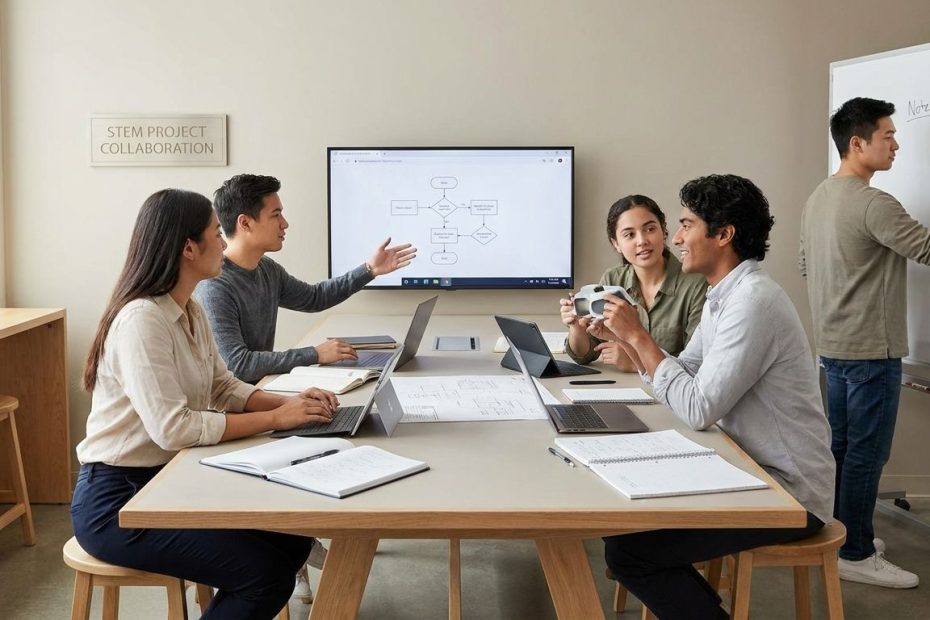
You lead a Science, Technology, Engineering, and Mathematics (STEM) group project without taking over by making the work visible, sharing decisions, and helping teammates solve problems instead of replacing their work with yours. Your job is to create structure, ask better questions, and protect shared ownership.
If you’re the person who cares about the grade, the deadline, and the quality of the final product, taking control can feel safer than trusting the group. The problem is that control often trades short-term speed for weaker learning, lower morale, and more work on your shoulders. This guide shows you how to lead with clarity, accountability, and confidence without becoming the person who does everything.
The Hidden Cost Of Taking Over: Why Your Help Hurts The Team
Taking over usually starts with good intentions. You see the code getting messy, the lab notes looking thin, or the design choices moving in the wrong direction, so you step in to protect the final result. That can work for one task, but it teaches the group that your judgment matters more than the team’s process. Over time, teammates contribute less because they expect you to fix or replace their work.
In STEM group projects, the process matters as much as the final answer. Your teammates need space to test ideas, make reasoned mistakes, compare approaches, and explain trade-offs. Research on cooperative learning shows that groups perform better when members share responsibility and remain individually accountable. A dominant leader can reduce that ownership by turning collaboration into approval-seeking.
There’s also a personal cost. If you manage every detail, you carry the mental load for the full project: scheduling, task tracking, quality control, conflict repair, and last-minute rescue work. That leads to burnout, resentment, and rushed decisions near the deadline. Strong leadership reduces that load by distributing it.
Redefining Leadership: From Commander To Catalyst
To lead a STEM group project without taking over, start by changing the role you assign yourself. You’re not the commander who supplies every answer. You’re the person who helps the group make better decisions together. That means you guide the process, clarify constraints, and invite contribution before jumping to a solution.
A commander says, “Use this method.” A catalyst asks, “What assumptions are we making, and how can we test them?” That shift matters in technical work because good solutions often come from comparing options. In an engineering design task, one teammate may think about materials, another may see a data issue, and another may catch a user requirement that everyone missed.
This kind of leadership still has authority, but it doesn’t rely on control. You can set agendas, document decisions, and call out missed commitments without acting superior. The tone is firm and collaborative: “Let’s decide who owns each part before we leave,” works better than, “I’ll just handle the important pieces.”
Start Strong: How To Co-Create The Project Charter And Roles
A group project goes wrong early when expectations stay vague. Before anyone starts coding, building, modeling, researching, or writing, create a short project charter. Keep it practical: goal, deliverables, task owners, deadlines, meeting rhythm, file storage, communication channel, and decision rules. You don’t need a long document; you need shared agreement.
Ask the group to build the charter together. If you write every rule alone, you’ve already started taking over. Invite each person to name their preferred work style, available hours, strengths, and areas where they want support. This makes delegation feel fairer because roles come from visible information rather than assumptions.
A useful charter also includes accountability. Decide what happens if someone misses a deadline, submits incomplete work, or goes quiet. That could mean a check-in message, a task split, a meeting with the instructor, or a peer evaluation note if your course uses one. Clear expectations reduce the urge to silently redo someone else’s part.
Play To Strengths: Matching Tasks To Skills Without Being Presumptuous
Fair delegation doesn’t mean every person does the same task. It means every person contributes meaningful work at a reasonable level of difficulty. In a STEM project, skill levels may differ across coding, statistics, lab technique, technical writing, design, presentation, or project coordination. Your role is to match work to strengths without locking anyone into a narrow lane.
Start by asking, not assigning. “Which part do you feel ready to own?” creates more buy-in than “You’re bad at coding, so you can make slides.” If a teammate has less technical experience, pair them with a task that builds skill and still supports the project. They could test code, document assumptions, review calculations, prepare diagrams, check units, or explain the method in the final presentation.
Strong technical members also need boundaries. If one person is excellent at programming, that doesn’t mean they should write the entire model alone. Split the work into design, implementation, testing, documentation, and review. That keeps quality high without turning expertise into control.
Guide, Don’t Dictate: Asking The Right Questions To Unblock Technical Work
When a teammate gets stuck, resist the reflex to grab the keyboard, rewrite the proof, or rebuild the prototype. Ask questions that help them diagnose the problem. Good technical leadership sounds like coaching: “What result did you expect?” “Where does the error first appear?” “Which assumption changed?” “What evidence supports that design choice?”
Questions slow you down for a moment, but they save time later. If you fix the issue yourself, the teammate may not understand what changed or why it worked. If they reason through it, the group gains another capable contributor. That is how you build capacity instead of becoming the bottleneck.
You can still step in when needed. The difference is that you explain your reasoning and leave a trail the group can use. In code, that could mean comments, a pull request note, or a short walkthrough. In lab or design work, that could mean a decision log that captures the constraint, the options, and the selected path.
When Things Go Off-Track: Navigating Conflict And Uneven Participation
Uneven work is one of the fastest triggers for taking over. If someone misses a deadline, your first move should be a direct, calm check-in. Use observable facts: “The data cleaning section was due Tuesday, and it’s not in the shared folder yet.” Then ask what support or adjustment is needed.
Don’t turn silence into secret labor. If you redo the work without naming the problem, the pattern usually repeats. Bring the issue back to the group charter and project board: “We need this part finished before analysis can start, so let’s decide who owns the next action.” This keeps the conversation about the project rather than personal blame.
If the issue continues, document it and use the process your instructor provided. Many courses include peer evaluation, group contracts, or instructor check-ins for this reason. Asking for help is not tattling when the grade depends on shared work. It protects the project and gives the teammate a fair chance to correct course.
The Tools That Keep Everyone In The Loop Without Micromanaging
Good tools reduce the need for constant reminders. A shared project board, spreadsheet, or document can show who owns each task, what status it has, and when it’s due. Trello, Notion, Google Docs, Google Sheets, and similar tools work well because they make progress visible. The tool matters less than the habit of updating it.
Use simple status labels: not started, working, blocked, ready for review, done. Add links to files, notes, datasets, diagrams, or calculations so teammates don’t waste time hunting for materials. If you’re leading, review the board during meetings instead of privately tracking everything in your head. That turns accountability into a shared view.
Avoid using tools as surveillance. You don’t need to comment on every tiny delay or edit. Focus on handoffs, blockers, deadline risks, and quality checks. The goal is transparency, not pressure.
Foster Accountability Through Peer Feedback And Check-Ins
Short check-ins keep a STEM project from drifting. Use a consistent rhythm: what was done, what comes before the next meeting, what is blocked, and what needs review. Keep it brief and specific. Long meetings often hide unclear ownership, so end every check-in with named tasks and deadlines.
Peer feedback works best when it happens before the final submission. Ask teammates to review one another’s work for accuracy, clarity, and fit with the project goal. In a data project, one person can review the method, another can check graphs, and another can test whether the explanation matches the results. This spreads quality control across the group.
Feedback should be about the work, not the person. Say, “This section needs the assumptions stated before the equation,” rather than, “You didn’t explain this well.” Specific feedback is easier to use and less likely to create defensiveness. It also helps you avoid the trap of rewriting everything yourself.
The Art Of Knowing When To Step Back And When To Step In
Stepping back doesn’t mean you’ve stopped leading. It means you’re giving the team enough room to own the work. If a teammate has a reasonable plan, the timeline allows testing, and the risk is manageable, let them proceed. You can ask for a review point instead of controlling the process.
Step in when the project is at real risk. That includes missed dependencies, unsafe lab practices, repeated noncommunication, unsupported claims in the final report, or technical decisions that conflict with the assignment requirements. When you step in, name the risk and propose a group decision. “The model output doesn’t match the stated assumptions, so we need to review the method before we write results,” is direct without being domineering.
The best leaders adjust their involvement as the group matures. Early on, you may need more structure because people are still figuring out roles and expectations. Later, you should be able to delegate more and focus on integration. If you’re still controlling every detail near the end, the system needs repair.
Beyond This Project: How Facilitative Leadership Prepares You For Real STEM Teams
STEM work rarely happens alone. Labs, engineering teams, research groups, software teams, and design studios depend on people who can coordinate expertise without flattening it. Learning to lead without taking over gives you practice in the skills employers and graduate programs value: planning, communication, accountability, technical judgment, and team learning.
You also become better at explaining technical choices. When you guide instead of dictate, you have to make reasoning visible. That helps the group defend its decisions in reports, presentations, demos, and design reviews. Strong STEM communication is not just about being right; it’s about helping others understand how the group got there.
This skill also protects your own growth. If you always take the hardest tasks, you may get a good grade, but you miss the chance to learn leadership under real constraints. Shared work teaches you how to trust, verify, adjust, and communicate under pressure. Those habits travel far beyond one class project.
How Can You Lead A STEM Group Project Without Taking Over?
- Facilitate, don’t dictate.
- Co-create roles and deadlines.
- Track work visibly.
- Ask questions before giving answers.
- Use brief check-ins.
Lead The Project Without Becoming The Project
To lead a STEM group project without taking over, build the conditions for shared ownership from the start. Set clear roles, make progress visible, ask questions that help teammates think, and use check-ins before problems turn into rescue missions. Step in when the work is at risk, but don’t confuse control with quality. A strong leader helps the group produce better work than one person could produce alone.
References
- Massachusetts Institute of Technology Teaching + Learning Lab: Using Group Work Effectively
- Carnegie Mellon University Eberly Center: How To Handle Difficult Group Dynamics
- Edutopia: 5 Strategies To Deepen Student Collaboration
- Inside Higher Ed: How To Manage A Group Project
- The Cooperative Learning Institute: What Is Cooperative Learning?
- American Society for Engineering Education PEER: Peer Evaluation And Student Team Research
- National Academies Press: Reaching Students, What Research Says About Effective Instruction In Undergraduate Science And Engineering

Chrysilios Chrysiliou is a commercial real estate executive at RDPH Properties, Inc. with a diverse background in aviation and entrepreneurship. A former Greek Air Force Academy graduate, flight instructor, and flight school co-owner, he now leverages decades of strategic leadership to identify and develop high-value real estate opportunities.