
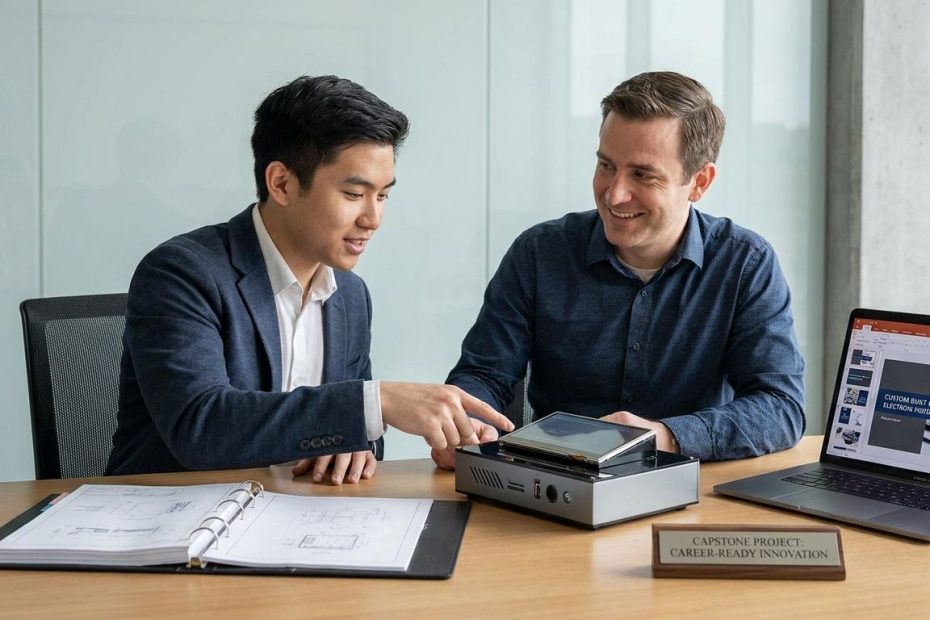
Your DIY capstone matters when it proves you can solve a real problem, make smart decisions under limits, and explain your work in a way a hiring manager can scan fast. If your project only shows that you followed instructions, it reads like coursework; if it shows judgment, outcomes, and communication, it starts working like resume evidence.
You’re about to build something that can do more than fill a portfolio slot. Done well, your capstone can strengthen your resume, sharpen your interview stories, and give employers clear proof that you can operate in a work setting, not just a classroom. The goal here is simple: help you design a project that looks relevant, finished, and worth talking about.
What Makes A DIY Capstone Employer-Ready?
An employer-ready capstone looks like work product, not homework. That means you choose a real problem, define who it affects, set constraints, build or analyze something useful, and document what you learned from the process. Employers reviewing student resumes keep looking for signals that you can do the job or grow into it fast, which is why applied project evidence carries weight when it’s presented well.
You should design your capstone around the skills employers actually screen for. National Association of Colleges and Employers, or NACE, ties career readiness to the demonstration of core competencies that prepare college graduates for workplace success, and it lists eight competencies, including communication, critical thinking, teamwork, professionalism, leadership, technology, and career and self-development. That gives you a clean test: if your capstone does not create visible proof of those abilities, you need to tighten it.
There’s another reason this matters. NACE reporting shows that only 38.1 percent of employers screen candidates by grade point average, which tells you employers are not relying on grades alone to decide who looks promising. Your project needs to show execution, not academic effort by itself. When you build a capstone that shows problem definition, decisions, tradeoffs, and results, you’re giving employers what grades often can’t show on their own.
How Do You Pick A Capstone Idea That Matches Real Jobs?
Start with job descriptions, not inspiration. Pull three to five postings for the role you want, then mark the repeated tools, deliverables, verbs, and business tasks. If data analyst roles keep asking for dashboards, data cleaning, stakeholder reporting, and business recommendations, your capstone should produce those outputs. If product roles keep asking for user research, prioritization, and roadmap thinking, your project should create those artifacts.
This move fixes one of the biggest student mistakes: building something interesting but irrelevant. A hiring team cares less about whether your idea sounds clever and more about whether it mirrors the kind of work they need done. Extern’s student portfolio guidance recommends reviewing job descriptions, extracting repeated skills and tools, and using those terms in project descriptions so your work matches how employers describe the role. That’s not gaming the system. That’s alignment.
You also need a realism layer. Add a real user, real data, a time limit, a budget cap, a messy workflow, or a quality requirement. Those details force you to make decisions, and decisions are what make projects believable. If everything is open-ended and consequence-free, your capstone feels like a sandbox. Employers care about what happens when you have to prioritize, cut scope, explain tradeoffs, and still ship something solid.
What Skills Should Your Capstone Prove?
Your capstone should prove problem-solving, teamwork, and communication before it tries to impress anyone with technical depth. Employer-facing career content from the National Institutes of Health, summarizing NACE’s Job Outlook findings, points to problem-solving, teamwork, and communication as the skills that rise to the top. NACE’s resume-focused guidance also says nearly 90 percent of employers seek evidence of problem-solving, and nearly 80 percent seek teamwork on resumes.
That gives you a direct design rule. For problem-solving, you need a written problem statement, constraints, and a record of how you tested options. For communication, you need a short brief, a clean presentation, a readable project page, or a walkthrough video that someone outside your field can follow. For teamwork, you need visible collaboration, which can come from partner check-ins, mentor feedback, issue tracking, peer review, contributor comments, or a client-style review loop.
Do not leave these skills implied. Put them into the project itself. Include a decision log. Save draft versions. Show failed directions and why you dropped them. Add a project summary that sounds like something you’d send to a manager. When employers scan student work, they’re looking for evidence, not guesses. Make the evidence easy to find.
How Big Should Your DIY Capstone Be?
Your capstone should be small enough to finish cleanly and deep enough to show judgment. For a solo project, four to eight weeks is usually enough to build meaningful proof without drifting into endless expansion. The sweet spot is a narrow problem with a visible output, a documented process, and a finished deliverable that feels polished. If you can’t define what “done” looks like in one sentence, the project is probably too broad.
Strong capstones usually have a tight finish line: a live demo, a report, a design prototype, a dashboard, a research memo, a working application programming interface, or a documented analysis with clear findings. Then you support that output with artifacts that show how you got there. A reflection, testing notes, metrics, screenshots, issue board, stakeholder memo, setup guide, and post-project review all help. Workforce LibreTexts highlights reflection and portfolio assembly as part of capstone presentation, which aligns with what employers want to skim after the project is built.
You do not get extra credit from employers for building something bloated. You get credit for finishing, explaining, and defending something useful. That’s why many student projects fail to land: the idea sounds ambitious, but the output looks incomplete. A modest project that works, has clear goals, and includes clean documentation will beat an oversized project with missing pieces almost every time.
How Do You Make A DIY Capstone Feel Like Real Work?
Treat the project like a client engagement. That’s one of the fastest ways to make your capstone read like professional experience. The Goldman School of Public Policy at the University of California, Berkeley describes capstone work as research and analysis conducted for a client, guided by faculty, with recommendations delivered in a professional report. That model works far beyond public policy. You can borrow the operating system even if you’re building your own project from scratch.
Write a one-page project brief at the start. Name the user, the pain point, the objective, the limits, the deliverables, and the success measure. Then create a simple cadence: kickoff, midpoint review, draft review, final delivery. If you don’t have an actual client, use a faculty member, mentor, student organization leader, local nonprofit contact, founder, or even a peer with relevant domain knowledge. The point is not title prestige. The point is outside feedback.
This changes your project in a useful way. You stop building what feels interesting in the moment and start building what solves the stated problem. You also create records that employers value: a scope statement, progress updates, revision notes, and a final recommendation or output. Those details make your capstone sound like project ownership instead of class participation.
What Deliverables Make Employers Pay Attention?
You want a short list of deliverables that make the project easy to review. The best stack is usually a primary output, a case study, and proof artifacts. The primary output is the thing itself, your dashboard, report, app, design file, automation, data model, research summary, policy memo, or prototype. The case study explains what the project is, why it matters, how you approached it, what changed during the process, and what result you reached.
Then come the proof artifacts. These are the pieces that separate real work from vague claims: screenshots, before-and-after comparisons, performance metrics, usability notes, interview summaries, testing logs, version history, project board snapshots, code repository links, and stakeholder feedback. Even if an employer never opens all of them, their presence adds credibility. You’re showing that the project has bones.
Keep each deliverable purpose-built. Your case study should be skimmable in under a minute. Your demo should work without setup pain. Your repository should be organized, labeled, and readable. If you include a short video, keep it focused on the problem, the solution, and the result. Busy reviewers decide fast, and your materials need to respect that reality.
What Should Your Readme Or Case Study Include?
Your project page needs to answer the questions a recruiter or hiring manager will ask in the first minute: what is this, who is it for, why does it matter, what did you do, and what happened? If someone has to hunt for the project’s purpose, you’ve already lost ground. Portfolio guidance from GitReady stresses that recruiters move on when they have to guess what a project does, and it also notes that many recruiters spend less than five minutes reviewing a portfolio before making an initial call.
That means your Readme or case study should open with a plain-English summary, not a technical dump. Start with the problem, then identify the user or stakeholder, then state the solution. After that, list the tools or methods and explain why you chose them. Add screenshots or visuals, show the process at a high level, and include results. If your project improved speed, reduced manual work, found trends, clarified decisions, or made something easier to use, state that directly.
You should also include tradeoffs and next steps. This is one of the most underrated ways to sound credible. A brief note on what you chose not to build, what you’d improve with more time, and what you learned from the results tells employers you can prioritize. That’s manager-friendly thinking. It shows you understand that no project happens in a vacuum.
- Problem statement
- User or stakeholder
- Goal and success metric
- Tools, methods, or tech stack with rationale
- Process summary
- Visual proof, screenshots, or sample output
- Results and measured impact
- Tradeoffs, limits, and next improvements
- Link to demo, report, or repository
Do Employers Care About GitHub, A Demo, Or The Story Behind The Project?
They care about all three, but not equally at the start. The first pass is usually about clarity and relevance. A reviewer wants to know what the project does, whether it connects to the role, and whether you can explain it like someone who owned the work. A live demo, strong visuals, or a short walkthrough often earns attention faster than a deep code review.
That doesn’t mean the repository is optional. It means the repository supports the story instead of replacing it. GitReady points to clean GitHub profiles, clear project descriptions, well-structured repositories, and easy navigation as key elements of a strong first impression. The same source includes a recruiter quote that says if the reviewer has to guess what a project does, they move on. That’s the standard you’re working against.
So build in layers. Lead with a clean project summary and a visible result. Add a two-minute walkthrough if your project benefits from motion or flow. Then give reviewers access to organized underlying materials, the repository, research notes, methodology, or documentation. This sequence works because it mirrors how hiring teams review candidate work under time pressure. Your capstone should be easy to skim and rewarding to inspect further.
How Do You Show Teamwork In A Solo Capstone?
You show teamwork by documenting collaboration points, not by pretending the project was team-built when it wasn’t. Employers want evidence that you can work with other people, absorb feedback, and improve the outcome without getting territorial about your draft. That can be shown in a solo capstone if you build collaboration into the workflow from the start.
Use scheduled feedback rounds. Ask a mentor to review your project brief, a peer to test your output, a faculty contact to challenge your assumptions, or a domain expert to comment on your recommendations. Capture what changed after each review. If you’re in software, use pull requests, issue comments, review notes, or contributor threads. If you’re in research, business, design, or operations, keep revision memos, meeting notes, annotated drafts, and stakeholder comments.
This matters because teamwork is not only about group assignment mechanics. It’s about whether you can move work forward with input from others. If your capstone includes a feedback loop and shows how outside input changed the final result, you’re giving employers a realistic teamwork signal. That’s stronger than listing “collaboration” on a resume with nothing underneath it.
How Do You Measure Results When You’re Still A Student?
You do not need million-dollar outcomes. You need believable measures tied to the problem you chose. If you built a dashboard, you can measure reporting speed, ease of interpretation, number of manual steps removed, or data error reduction. If you created a research memo, you can measure decision readiness, issue clarity, stakeholder usability, or how well your recommendations answered the original brief.
Results can be quantitative or qualitative, but they must be specific. “Improved efficiency” is weak. “Reduced a 12-step manual reporting workflow to 4 steps” is usable. “Designed a better user experience” is vague. “Three testers completed the task without guidance after layout changes” gives a hiring manager something to hold onto. Even small sample sizes are fine if you explain them honestly and tie them to the scope of the project.
You should also separate outcome from output. The output is the thing you built. The outcome is what changed because it exists. Employers care more about outcomes because that’s how work is judged on the job. Your capstone becomes more valuable the moment you explain not just what you made, but what it helped someone do.
How Do You Turn Your Capstone Into Resume Evidence?
Your project becomes resume evidence when you write it like work experience, not like a class title. Start with a concise project name and a label that fits the role you want, then describe the scope, the tools or methods, and the result. Use strong verbs. Show ownership. Keep each bullet tied to action and outcome.
NACE’s career readiness material frames workplace value around demonstrated competencies, and that gives you a smart way to rewrite project bullets. If you want your resume to communicate critical thinking, technology use, communication, and teamwork, your bullets should mention analysis performed, recommendations delivered, stakeholder materials created, systems built, testing completed, and revisions made after feedback. You’re translating school work into employer language.
A good capstone bullet sounds like this in structure: identified a problem, built or analyzed a solution, delivered a result, and documented the business or user value. That format works across software engineering, data analytics, product management, design, business operations, and research-heavy roles. Keep it tight. Save the full story for the project page and the interview.
What Mistakes Make A Capstone Easy To Ignore?
The biggest mistake is choosing an idea that is too broad, too generic, or too close to a tutorial. If your capstone looks like something anyone could copy in a weekend without making choices, it won’t signal much. Employers are not looking for maximum flash. They’re looking for evidence that you can frame a problem, work through it, and communicate the result in a way that fits the role.
The second mistake is weak packaging. Students often spend weeks building and almost no time explaining. That’s backwards. If the summary is unclear, the visuals are missing, the documentation is messy, and the outcome is buried, reviewers won’t do detective work. You need a sharp title, a clear problem statement, an obvious result, and a project page that respects limited attention.
The third mistake is hiding the reasoning. Employers care about how you think. If your capstone only shows the final polished answer, you miss a chance to prove judgment. Include the rejected options, the constraint you hit, the tradeoff you made, and what you changed after review. That’s where the real signal lives.
What Does A Strong DIY Capstone Workflow Look Like From Start To Finish?
You can keep the workflow simple and still make it look professional. Start by choosing a target role and reviewing job descriptions. Then define a narrow problem and write a one-page brief. Set a short timeline with milestones, identify your reviewer or client-style contact, and decide what the final deliverables will be before you build anything.
During execution, track your decisions and save proof. Keep notes on what changed and why. Run small tests, gather feedback, and revise the work based on what you learn. Build the project page while the project is in motion, not after you’re tired of it. That makes the final presentation more accurate and much easier to finish.
When you wrap up, package everything for fast review. Publish the main output, finalize the case study, clean the repository or files, and write resume bullets that match your target role. Then practice a short verbal explanation so you can explain the capstone in an interview without rambling. If you can describe the problem, the decision points, and the outcome in under two minutes, you’re in good shape.
- Review target job postings
- Choose one narrow, relevant problem
- Write a project brief with scope, user, and goal
- Set timeline, milestones, and review points
- Build the core deliverable
- Capture feedback, testing, and revisions
- Measure outcomes with clear metrics
- Publish the case study, demo, and supporting materials
- Convert the work into resume bullets and interview stories
What Do Employers Want From A Student Capstone?
- A real problem with a defined user or stakeholder
- Clear proof of problem-solving, communication, & teamwork
- A finished deliverable with measurable results
- Easy-to-scan documentation, demo, or portfolio page
Build Something Worth Discussing In The Interview
Your DIY capstone should make an employer’s job easier: they should be able to see what you solved, how you worked, and why your result matters without digging through clutter. When you align the project to real job descriptions, build around career-readiness skills, and package the work with clean documentation, your capstone starts pulling real weight on your resume. You do not need the biggest idea in the room. You need a finished project with a sharp problem statement, visible decisions, and proof that you can handle work the way employers expect. If you design it with that level of intent, your capstone stops being a class-adjacent side project and starts becoming one of the strongest pieces of career evidence you own.
References:
- National Association of Colleges and Employers, What Are Employers Looking for When Reviewing College Students’ Resumes?
- National Association of Colleges and Employers, What Is Career Readiness?
- National Association of Colleges and Employers, NACE Quick Poll: More Than 83% of Respondents Implementing Career Readiness Competencies
- National Institutes of Health, Top Skills Employers Are Looking for in 2025: Problem-Solving, Teamwork, and Communication
- University of California, Berkeley Goldman School of Public Policy, Capstone Projects
- GitReady, What Recruiters Look for in Developer Portfolios
- Extern, Student Portfolio Examples 2026: Formats, Real Projects & Templates
- National Association of Colleges and Employers, Job Outlook Spring Update

Chrysilios Chrysiliou is a commercial real estate executive at RDPH Properties, Inc. with a diverse background in aviation and entrepreneurship. A former Greek Air Force Academy graduate, flight instructor, and flight school co-owner, he now leverages decades of strategic leadership to identify and develop high-value real estate opportunities.