
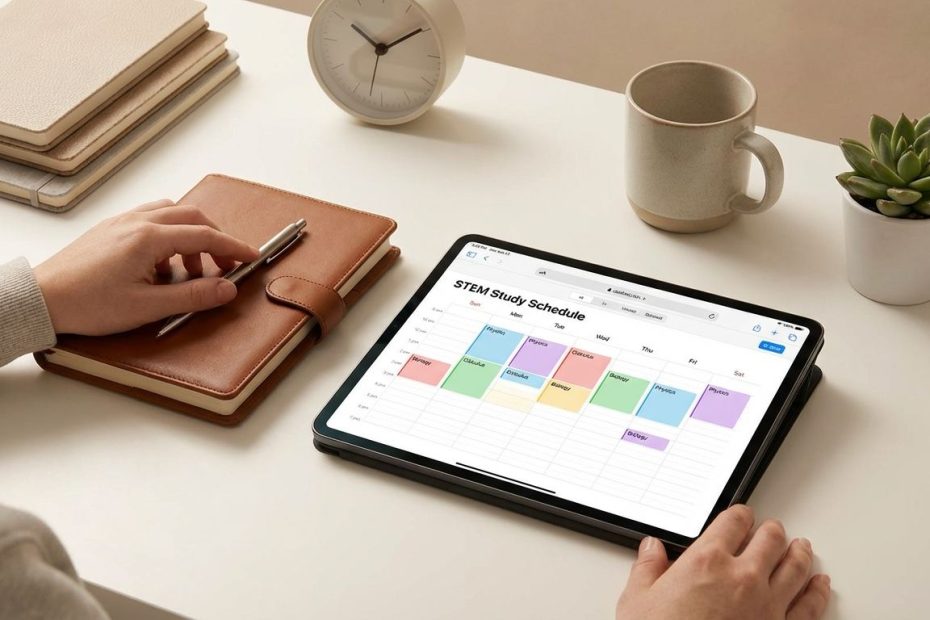
You ace a STEM degree by treating it like skill training, not information intake: you budget time by credit hours, study with retrieval and problem practice, and use support systems early so difficulty never gets the chance to compound.
This guide helps you set a realistic weekly workload, build a study system that matches STEM exams, and protect your energy so performance stays consistent. You’ll finish with a plan you can run on busy weeks, exam weeks, lab weeks, and weeks when motivation dips.
How Many Hours Should You Actually Study Each Week For A STEM Degree?
Use a credit-hour baseline, then adjust using your results. Many colleges communicate an expectation close to 1 hour in class plus at least 2 hours outside class per credit per week across the term, which turns a 15-credit schedule into a workload that can resemble a full-time job once labs, commuting, and life tasks enter the picture.
Translate that into a weekly plan you can execute. Start by listing fixed time, lectures, labs, recitations, mandatory discussion sections, then add flexible time, problem sets, reading, pre-labs, coding assignments, and exam prep. If the math says the week is overloaded, the fix is not “work harder.” The fix is reducing credits, reducing paid work hours, or tightening the study method so fewer hours produce better mastery.
A practical way to manage the variability is to run a two-speed schedule. Keep a steady baseline Monday through Thursday, then reserve one longer block on the weekend for consolidation. This matches what students often report informally: ordinary weeks feel manageable, then midterms and finals create spikes, and spikes become chaos when no buffer exists.
Use performance checkpoints to calibrate. If quiz scores, homework accuracy, or lab write-ups slip, add time in the highest-yield place: timed practice and correction, not rereading. If everything stays solid with fewer hours, protect that efficiency and keep a small daily review habit so the system still holds when courses ramp up later.
What Does “Thriving” In STEM Look Like Beyond Grades?
Thriving means your grades, health, and confidence all remain stable across the term. Many students can brute-force an exam week and still pass, yet the cost shows up as missed labs, late work, skipped meals, poor sleep, and a constant feeling of being behind. That pattern rarely scales into upper-division courses where material stacks and speed matters.
Measure thriving with operational metrics, not vibes. Track how many assignments are started within 24 hours of release, how often office hours are used before deadlines, how many practice problems are completed under time pressure, and how many nights include consistent sleep. These are leading indicators, they predict outcomes before grades arrive.
Thriving also shows up in how you respond to confusion. A surviving student hides gaps and hopes the exam avoids them. A thriving student isolates the gap, captures it in an error log, and resolves it via targeted practice or a single focused question to a TA, tutor, or instructor.
Why Do STEM Classes Feel Harder Than Non-STEM (And What Should You Do About It)?
STEM classes often grade fluency, not familiarity. You can recognize a formula and still fail if you cannot choose it under pressure, apply it correctly, and execute without algebra mistakes. That reality changes the entire study design: passive review creates comfort, but comfort is not competence.
Build your week around retrieval and practice. Retrieval means you attempt to recall and apply without looking. Practice means you do enough problems to build speed, pattern recognition, and error resistance. Reading and watching videos still matter, yet they serve as preparation for practice, not the main event.
Operate with a three-layer routine. Pre-class is light, skim objectives, key definitions, and the types of problems coming. Post-class is short, redo one or two representative problems from memory and write down where you hesitated. Weekly work is deep, timed sets, corrections, and reattempts of what went wrong until the mistake pattern disappears.
What Study Methods Work Best For Calculus, Physics, Chemistry, And Computer Science?
Use methods that force correct recall and correct execution. Start with a one-page concept sheet per topic that includes formulas, unit cues, boundary conditions, and common traps. Keep it short enough that it stays usable during revision and becomes a mental map for selecting tools on exams.
Then shift into micro-sets. Complete 5 to 10 problems per day per course, mixing easy, medium, and one stretch problem. Mix matters because exams mix, and your brain learns selection when the right tool is not pre-announced. After each set, correct immediately and write one sentence on the real cause of the error, misread prompt, wrong model, algebra slip, unit mismatch, off-by-one bug.
Add an error log that behaves like a training plan. Every missed problem becomes a prompt you will reattempt later without notes. Schedule the reattempt 2 days later and again 7 days later, so weak spots stop returning at the worst time. This spacing rhythm is where many students gain points without adding endless hours.
For coding-heavy courses, treat problems like drills. Implement a solution, then write tests, then refactor, then re-implement from scratch a few days later. That last step feels strict, yet it builds the speed needed for timed assessments and technical interviews, and it reduces the “blank screen” problem when you sit down to start an assignment.
You’re Doing Fine Without Studying Much, Will It Catch Up Later?
It can, depending on how the program stacks prerequisites. Intro courses may reward strong background knowledge and consistent homework, so it is possible to earn strong grades with limited deliberate practice. Upper-division courses tend to punish weak habits because they expect quick recall, multi-step reasoning, and endurance across long problem sets, labs, or projects.
Protect future you by adding one small non-negotiable habit now: a 20 to 30 minute post-class recap that includes one retrieval attempt and one correction. That single block often prevents the common failure mode where the first serious review happens two days before an exam, when the course has already moved on.
Keep the workload honest. Homework counts as studying in STEM when it is done thoughtfully, without copying, and with correction. If “not studying much” actually includes hours of problem sets and labs, that can still be a solid system. The risk appears when the work is rushed, outsourced to answer keys, or completed without a correction loop.
How Do You Manage A Heavy STEM Course Load Without Burning Out?
Start with time math and commit to it. List fixed obligations, class time, lab time, commuting, job hours, meals, sleep, then compute what remains. Many students feel behind because they plan with imaginary time that never existed in the week. Once the math is visible, the plan becomes a scheduling problem, not a character judgment.
Run your weekdays on two deep-work blocks. Schedule one block for problem-heavy work and one block for writing, coding, or lab reporting. Keep blocks at 60 to 90 minutes and end with a written restart note that says exactly what to do next time. Restart notes reduce wasted warm-up time, which is a major hidden cost in STEM studying.
Protect one half-day per week for recovery and light maintenance. That half-day can include short spaced review, basic planning, and life admin, yet it should avoid heavy graded work. This keeps energy stable and makes exam weeks less destructive because the baseline stays intact.
When overload persists, negotiate reality. Reduce credits, switch one course to a lighter term, or replace a difficult elective with a required course you already need. If a job is necessary, tighten the study method around retrieval and correction, and use office hours to prevent hours of stuck time that burn energy without producing progress.
How Do You Use Office Hours, Tutoring, And Study Groups Effectively In STEM?
Use office hours to save time, not to prove effort. Show up with the exact problem, your attempt, and the precise step where it breaks. That preparation turns a 10-minute conversation into a breakthrough and prevents a one-hour spiral at home. It also builds a working relationship with the people who write or influence the assessments.
Tutoring works best when you arrive with data. Bring your last quiz, highlight missed categories, and ask for drills targeting the category, not a re-teach of the whole unit. Tutors can also help you build an error log and reattempt schedule, which often matters more than one more explanation of the concept.
Study groups must be structured to avoid turning into shared confusion. Keep them short, agenda-driven, and focused on teach-back and timed practice. A clean format is: each person shares one confusion, each person teaches one problem at the board, then the group creates five practice prompts and disperses. If focus fails, limit group time to practice exams and do learning solo.
How Many Hours Should You Study Per Week In STEM?
- Plan 2–3 hours outside class per credit per week.
- 15 credits often means 30–45 hours outside class, plus lectures and labs.
- Adjust using quiz scores, homework accuracy, and stress level.
Build Your Week, Protect Your Energy, And Let The Grades Follow
A STEM degree rewards repeatable execution: consistent time budgeting, retrieval-driven study, and fast feedback through correction and reattempts. Set a credit-hour baseline, then tune the system using real performance signals, not guesswork. Use office hours and tutoring as time multipliers, and keep study groups structured so they raise accuracy instead of spreading confusion. Keep sleep and recovery stable because fatigue produces careless errors that erase hours of work. Implement this plan early, and the “hard semesters” become manageable workloads instead of emergencies.
References
- Federal Student Aid Handbook 2024–2025, Volume 2, Chapter 2: Program Eligibility, Written Arrangements, and Distance Education
- Purdue University Parent & Family: OnBoard Newsletter Vol. 07 (Student Success and Study Time Guidance)
- Reddit r/college: “How many hours a week should I study in my first year?”
- Reddit r/studytips: “Is this the right way?”
- Reddit r/college: “Studying engineering”
- Reddit r/ufl: “Engineering”
- Reddit r/EngineeringStudents: “How many hours per week, on average, do you put in for your classes?”

Chrysilios Chrysiliou is a commercial real estate executive at RDPH Properties, Inc. with a diverse background in aviation and entrepreneurship. A former Greek Air Force Academy graduate, flight instructor, and flight school co-owner, he now leverages decades of strategic leadership to identify and develop high-value real estate opportunities.