
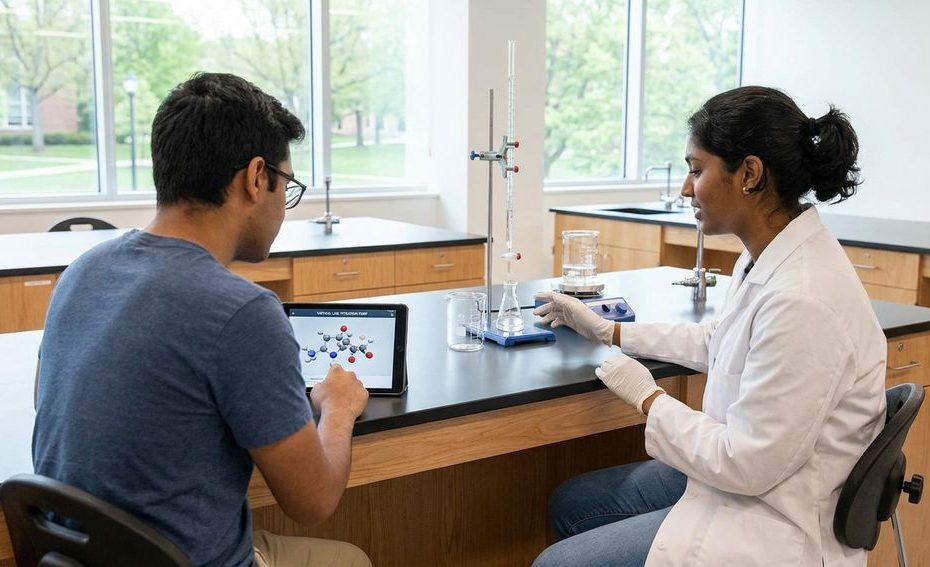
Virtual labs give you a digital space to run experiments, test variables, repeat procedures, and review results without relying on constant access to physical equipment. In Science, Technology, Engineering, and Mathematics (STEM) education, they strengthen preparation by letting you practice decisions and concepts before working with real materials.
Used well, virtual labs can expand access, support repeated practice, and connect scientific theory with observable results. They also help instructors identify misunderstandings before students begin costly, time-sensitive, or equipment-dependent work. Their strongest role is usually preparation and reinforcement, rather than replacing every physical laboratory experience.
What Is A Virtual Lab In STEM Education?
A virtual lab is an interactive digital environment where you conduct simulated experiments or complete laboratory activities through a computer or compatible device. Depending on the subject, you may adjust variables, operate simulated instruments, collect measurements, analyze data, or follow a procedural sequence.
These environments range from two-dimensional simulations to immersive systems that reproduce parts of a laboratory workspace. A chemistry simulation may let you change concentrations and observe a reaction, whereas an engineering lab may allow you to modify a circuit, machine setting, or structural load. The software records how the simulated system responds, giving you evidence to interpret rather than a fixed demonstration to watch. That interaction separates a virtual lab from a standard instructional video.
Virtual labs now appear across chemistry, biology, physics, engineering, medicine, and related fields. A review of undergraduate science and engineering research examined 25 empirical papers and found that many early virtual labs focused on individual content knowledge through single-screen software. Later research has paid closer attention to student engagement, instructional design, social learning, and the relationship between digital and physical practice.
How Do Virtual Labs Improve STEM Practice?
Virtual labs improve practice by letting you repeat an experiment, adjust one condition at a time, and study the effect of each decision. You can build procedural familiarity without consuming materials or waiting for shared equipment.
Repeated practice matters when a procedure contains several dependent steps. If you select the wrong setting or misunderstand a measurement, the simulation can let you restart and trace where the error occurred. That feedback turns mistakes into visible learning events. You can compare attempts, revise your method, and test whether the correction produces a better result.
Research supports the academic value of this form of practice. A meta-analysis of virtual laboratories in engineering education included 46 studies drawn from 22 publications and reported an overall effect size of 0.686 for educational outcomes. The analysis also found strong results for learning motivation and engagement, though results can vary by lab design, course structure, assessment method, and student group. The software alone doesn’t create better learning; the activity must require you to predict, test, measure, and explain.
How Are Virtual Labs Changing Preparation Before Hands-On Work?
Virtual labs are turning laboratory preparation into active rehearsal instead of passive reading. Before entering a physical lab, you can review the workflow, locate important controls, practice calculations, and identify points where errors are likely.
Traditional preparation often relies on written protocols, diagrams, or demonstrations. Those resources explain what you’ll do, but they don’t always test whether you can make the correct decision at the correct moment. A virtual exercise can ask you to choose equipment, set values, predict an outcome, and respond when the data doesn’t match your prediction. By the time you reach the physical workspace, the sequence is familiar and your attention can shift toward technique and observation.
This form of preparation can also make scheduled laboratory time more productive. You’re less likely to spend the opening part of a session decoding basic instructions, and instructors can focus on reasoning, accuracy, and safe equipment use. In courses with limited laboratory hours, that shift helps preserve physical lab time for tasks that need real materials. Virtual preparation also gives instructors performance data they can use to review recurring errors before a class begins.
Can Virtual Labs Replace Physical Laboratories?
Virtual labs can replace some concept-based activities, but they cannot reproduce every physical skill or sensory observation. A blended model usually gives you the broadest preparation because digital practice supports conceptual learning and physical labs develop technique.
A systematic review of virtual physiology laboratories found that digital labs supported concept learning. The evidence was less certain for motivation and technical skill development, and blended models performed at least as well as in-person laboratories for conceptual outcomes. A later review of virtual and blended laboratories in healthcare education also found the strongest effects in cognitive learning, with smaller effects in hands-on skill development.
That distinction matters. A simulation can teach you why a procedure works, what variables affect the outcome, and how to interpret the resulting data. It cannot fully reproduce equipment resistance, material texture, manual calibration, specimen variation, or the coordination needed for precise physical work. When those abilities are part of the learning objective, you still need direct practice with real tools and materials.
Which STEM Skills Benefit Most From Virtual Labs?
Virtual labs are well suited to conceptual reasoning, experimental design, data interpretation, and decision-making. They help you see relationships that may be difficult to isolate during a fast-moving physical experiment.
You can change one variable, hold the others steady, and compare the results across several runs. That process supports hypothesis testing and helps you distinguish correlation from a controlled experimental effect. Many platforms also generate tables, graphs, or measurement records, giving you material for quantitative analysis. When an activity asks you to justify your choices, it can strengthen scientific communication alongside technical knowledge.
Digital practice can also develop troubleshooting habits. An engineering student can test how a system responds to a changed input, and a biology student can review how an altered condition affects a simulated process. You learn to inspect the available evidence, locate a likely source of error, and choose the next test. Physical technique still requires physical practice, but the reasoning behind that technique can begin in a virtual environment.
How Do Virtual Labs Expand Access To STEM Practice?
Virtual labs give you more opportunities to practice when physical equipment, materials, space, or scheduling are limited. If the platform works on your available device and internet connection, you can often access the activity beyond a scheduled laboratory period.
Physical laboratories depend on facilities, maintenance, supervision, consumable materials, and enough equipment for each class. Digital labs reduce some of those constraints, particularly for activities centered on concepts and data analysis. A class can repeat an experiment without using another set of materials, and students can revisit a difficult procedure outside the original session. This flexibility is useful when learners enter a course with different levels of prior laboratory experience.
Access still depends on practical conditions. Device compatibility, internet reliability, software licensing, accessibility features, and technical support all affect whether the lab works for every student. Schools also need alternatives when students cannot run the software reliably. Expanding access requires more than purchasing a platform; it requires testing how students will reach, use, and complete the activity.
What Makes A Virtual Lab Effective?
An effective virtual lab connects every digital action to a defined learning goal. You should know what you’re investigating, which evidence you need to collect, and how your choices affect the simulated system.
Strong activities ask you to make predictions before revealing results. They provide feedback without removing the need to think, and they require you to interpret data rather than click through a preset sequence. Useful lab prompts may ask you to compare trials, explain an unexpected result, identify an experimental limitation, or connect the findings to a scientific principle. These tasks turn software interaction into disciplined practice.
Instructor preparation also affects the result. A meta-analysis covering 92 studies of digital tools in secondary mathematics and science found a positive overall effect on student learning, with simulations among the stronger tool categories. Teacher training changed the size of the effect, and digital tools generally performed better when added to other instruction rather than used as direct substitutes. You gain more from a virtual lab when it connects to discussion, feedback, assessment, and later hands-on work.
How Should Schools Choose And Implement Virtual Labs?
Schools should choose virtual labs by comparing learning goals, student needs, technical requirements, instructional controls, and assessment options. Visual quality matters less than whether the activity produces useful practice and measurable evidence of learning.
Start by defining the task students must perform after the activity. If the goal is data analysis, the lab should produce meaningful measurements that students can compare and explain. If the goal is procedural preparation, the simulation should reproduce the order of decisions and common errors. If manual technique is the main objective, a virtual lab should serve as preparation rather than the only learning environment.
Implementation should begin with a limited course unit before expanding across a department. Review completion data, student explanations, assessment results, technical problems, and instructor workload. Compare those findings with the previous version of the activity rather than relying only on student satisfaction. Keep the lab when it improves readiness, practice quality, or understanding, and revise it when students can finish without demonstrating the intended skill.
What Are The Main Benefits Of Virtual Labs?
- Repeat experiments without using new materials.
- Practice procedures before hands-on work.
- Test variables and review immediate results.
- Build conceptual reasoning and data skills.
- Access more practice beyond scheduled lab time.
Use Virtual Labs To Prepare, Practice, And Verify
Virtual labs are changing STEM preparation by giving you room to rehearse, make mistakes, and examine results before limited physical lab time begins. Their strongest uses include concept learning, experimental planning, data analysis, troubleshooting, and procedural readiness. They become less suitable when the objective depends on manual control, sensory observation, or direct equipment handling. A blended design connects digital repetition with real materials, instructor feedback, and physical technique. Choose virtual labs for the learning work they perform well, then measure whether they improve what students can explain and do.
References
- Effectiveness of Virtual Laboratory in Engineering Education: A Meta-Analysis
- Are Virtual Physiology Laboratories Effective for Student Learning?
- Virtual or Blended Laboratories for Healthcare Student Education
- Virtual Laboratories in Undergraduate Science and Engineering Courses
- Digital Tools for Mathematics and Science Learning in Secondary Schools.

Chrysilios Chrysiliou is a commercial real estate executive at RDPH Properties, Inc. with a diverse background in aviation and entrepreneurship. A former Greek Air Force Academy graduate, flight instructor, and flight school co-owner, he now leverages decades of strategic leadership to identify and develop high-value real estate opportunities.