
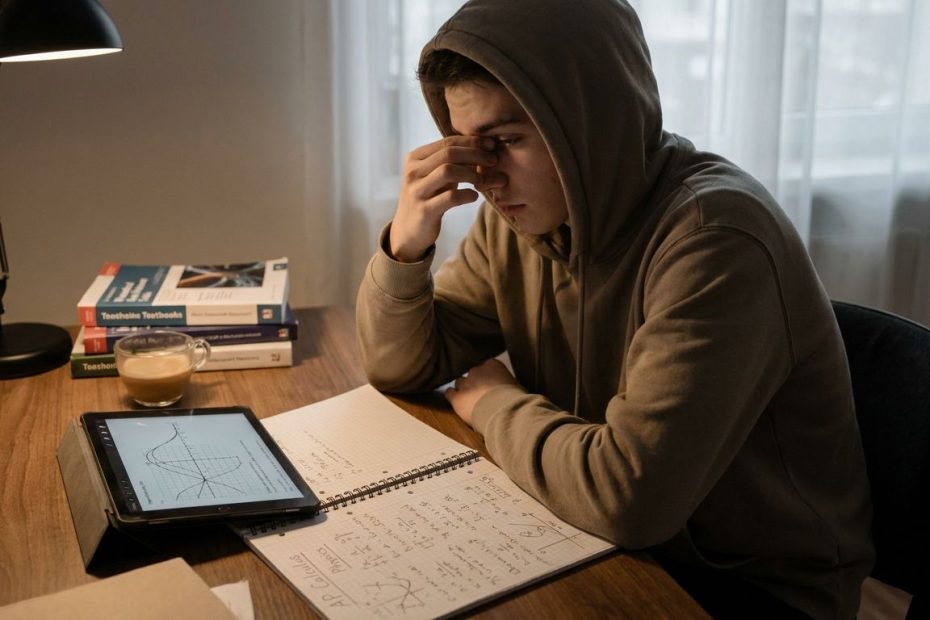
Science, technology, engineering, and mathematics (STEM) burnout starts earlier than students expect because pressure, math anxiety, fixed ability beliefs, and weak belonging often begin before college. Many students start disconnecting from STEM in middle school, long before a difficult freshman lecture or major declaration.
If you’re seeing a student lose curiosity, avoid math, dread science class, or say “I’m just not a STEM person,” you’re probably not looking at laziness. You’re looking at early academic burnout taking shape. This article explains where that burnout begins, why it grows so fast, and how parents, teachers, and schools can protect rigor without turning STEM into a survival test.
Why Does STEM Burnout Start Before College?
Direct Answer: STEM burnout starts before college because students begin attaching stress, identity, and self-worth to math and science performance years earlier. By the time college starts, many have already spent years feeling judged instead of curious.
The public story often treats STEM attrition as a college problem. A student enters engineering, struggles through calculus or chemistry, then switches majors. That happens, but the roots usually run deeper. National Center for Education Statistics research found that many students who begin college in STEM leave the field before graduation, with attrition higher among associate’s degree entrants than bachelor’s degree entrants.
The earlier warning sign is quieter: interest fades before the transcript shows a change. A child who once liked building, coding games, collecting rocks, or asking science questions can start seeing STEM as worksheets, speed drills, and rankings. Once that shift happens, effort no longer feels like exploration. It feels like proof of whether the student belongs.
You can spot the pattern when a student says, “I used to like science, but now I’m bad at it.” That sentence blends interest, identity, and performance into one painful label. STEM burnout starts earlier than students expect because the system often asks them to decide who they are before they’ve had enough room to learn how STEM works.
How Early Can Math Anxiety Begin?
Direct Answer: Math anxiety can begin in the early elementary years, and it can shape later STEM avoidance if students connect math with fear, speed, or public failure. Early fear can become a long-running belief that math ability is fixed.
Research summarized by the University of Chicago notes that math anxiety can begin as early as first grade. That matters because early math is often treated as harmless practice: timed facts, quick answers, public corrections, and visible comparison. For some students, those moments teach a damaging lesson. They start to believe math is not something you learn, but something that exposes you.
Once fear enters the picture, working memory can suffer. A student may understand a concept during practice, then freeze during a quiz. Adults may misread that freeze as poor preparation. The student may read it as evidence that their brain “isn’t made for math.”
This is one reason early STEM burnout can look like avoidance instead of exhaustion. The student forgets homework, delays studying, jokes about being bad at math, or chooses easier tasks. Underneath those behaviors is often a protective move: if they don’t engage fully, they don’t have to face another moment of feeling incapable.
Why Does Middle School Become A STEM Sorting Machine?
Direct Answer: Middle school becomes a STEM sorting machine because students encounter harder content, stronger peer comparison, and early tracking at the same time their academic identity is forming. Interest can drop fast when STEM stops feeling connected to real life.
Middle school is a major turning point because students begin to ask where they fit. They notice who gets called “smart,” who finishes fastest, who enters advanced math, and who receives extra encouragement. At the same time, science and math can become more abstract. If lessons feel detached from problems students care about, curiosity gives way to compliance.
Research covered by The Hechinger Report found that by eighth grade, nearly half of students saw science as irrelevant to their future careers. That finding should make any parent or school pause. Students are not only deciding whether they can succeed in STEM. They’re deciding whether STEM has anything to do with their life.
The middle school years also harden labels. “Advanced,” “regular,” “gifted,” “behind,” “math person,” “not a math person” — these words stick. A student placed outside the top track may assume the decision says something permanent. A student inside the top track may fear losing that status with every test.
Why Do Students Feel Cynical Before Calculus?
Direct Answer: Students can feel cynical before calculus because high school STEM often rewards performance under pressure more than curiosity, collaboration, or patient problem-solving. Burnout can appear in advanced classes before college begins.
High school can turn STEM into a scoreboard. Students often juggle advanced courses, grade point average pressure, college applications, competitions, test preparation, and extracurriculars. For a motivated student, that load can feel manageable at first. Over time, the same student may begin to feel emotionally drained and detached from the work.
Research on high school students in advanced STEM courses found signs aligned with the classic burnout pattern: emotional exhaustion, cynicism, and reduced academic self-efficacy. That means the student is not only tired. They may start thinking the subject is pointless, the class is unfair, or their effort no longer changes the outcome.
This is where adults often miss the warning signs. A student with strong grades can still be burned out. The report card may show success, yet the student’s relationship with learning may be breaking down. If STEM becomes a constant test of worth, high achievement can hide the damage for a long time.
Why Do Students Decide They Are Not Science People?
Direct Answer: Students decide they are not science people when repeated messages make STEM feel reserved for a narrow type of learner. Belonging, role models, and classroom culture can shape persistence as much as ability.
STEM identity forms through daily signals. Who gets encouraged to ask questions? Whose mistakes are treated as normal? Who sees adults and older students who resemble them succeeding in technical fields? These signals can build confidence, or they can make a student feel like a visitor in the room.
National Girls Collaborative Project data shows that girls perform as well as or better than boys in math and science in kindergarten through grade twelve, yet their confidence and interest often drop between ages ten and fourteen. Microsoft’s research on girls and STEM also points to role models and real-world relevance as major factors in sustained interest. The point is not that one group lacks ability. The point is that ability does not protect a student from belonging pressure.
Students from groups with weaker representation in certain STEM fields can face extra mental load. They may feel they have to prove they belong every day. A single low score can feel personal, not temporary. That constant self-monitoring drains energy that should be available for learning.
How Does Perfectionism Turn STEM Into A Burnout Trap?
Direct Answer: Perfectionism turns STEM into a burnout trap when students see every mistake as a verdict on intelligence. STEM requires mistakes, revision, and uncertainty, so perfectionism makes normal learning feel like failure.
Many students enter advanced STEM tracks with a dangerous rule in their head: good students get it right quickly. That rule may work in early school, where memorization and speed often earn praise. It breaks down in harder math, laboratory work, engineering design, and computer programming. The work gets messier, and the student thinks they are the problem.
Studies on growth mindset and fixed mindset show why this matters. Students who believe intelligence is fixed are more likely to disengage when work becomes difficult. A hard problem no longer feels like a normal part of learning. It feels like exposure.
The Advanced Placement arms race can amplify this pattern. Students stack advanced classes to stay competitive, then measure themselves against classmates who seem calmer or faster. Parents may push more practice, more tutoring, and more résumé-building. Support helps when it restores confidence and skill, but pressure backfires when it teaches students that rest is weakness and a lower grade means they do not belong.
Why Do College Weed-Out Courses Make Earlier Burnout Worse?
Direct Answer: College weed-out courses make earlier burnout worse because they often confirm fears students developed years earlier. Large, competitive gateway classes can weaken belonging instead of helping students build skill.
Introductory college courses in calculus, chemistry, physics, and related subjects are often treated as filters. The message is blunt: only the strongest survive. National Academies research found that this kind of course culture can discourage women and underrepresented minority students in particular, especially when instruction feels competitive and support is limited.
The problem is not rigor. STEM should be demanding. The problem appears when rigor is confused with isolation, harsh curves, limited feedback, and the belief that struggling students should simply leave. A hard course can build confidence when it includes clear expectations, guided practice, accessible help, and respect for questions.
If you’re a student arriving in college already worried that you are not a STEM person, a weed-out course can feel like confirmation. One exam can seem to settle the matter. That is how early burnout becomes college attrition: the student leaves not because they never had talent, but because the learning environment keeps translating difficulty into exclusion.
What Can Parents, Teachers, And Schools Do To Reduce Early STEM Burnout?
Direct Answer: Adults can reduce early STEM burnout by protecting curiosity, normalizing mistakes, teaching study strategies, and connecting STEM to real problems. Students need challenge paired with belonging, not pressure without support.
Parents can start by changing the language around ability. Replace “You’re so smart” with feedback about strategy, persistence, and revision. Ask what the student tried, where they got stuck, and what helped. That keeps effort connected to growth rather than identity.
Teachers can design STEM learning that includes productive struggle without public shame. Inquiry-based lessons, project-based learning, low-stakes practice, and structured collaboration help students see STEM as a way of thinking. A classroom can still prepare students for exams without making speed the only visible form of competence. When students solve problems connected to health, energy, design, transportation, climate, food systems, or local needs, relevance becomes easier to feel.
Schools can review tracking, grading, and course-entry policies that send early “you belong” or “you don’t” messages. Mentorship matters too. Students benefit from seeing older peers, teachers, family members, and professionals who can explain how STEM learning really develops. The goal is not to make STEM easy. The goal is to make difficulty survivable, meaningful, and worth returning to.
Why Does STEM Burnout Start In Middle School?
- STEM burnout starts when math fear hardens.
- Students lose real-world relevance.
- Peer comparison grows.
- Belonging feels uncertain.
Keep The Spark From Becoming A Score
STEM burnout starts earlier than students expect because the first break often happens quietly: a timed math test, a discouraging placement, a class that rewards speed over thought, or a year when science stops feeling connected to anything real. If you want students to stay in STEM, protect the link between effort and possibility. Watch for cynicism, avoidance, exhaustion, and “I’m not a STEM person” language before grades collapse. Strong STEM education can still be demanding, but it should teach students how to recover from confusion, use feedback, ask better questions, and find belonging in the work. The students most likely to persist are not the ones who never struggle; they’re the ones who learn that struggle is part of becoming capable.
Reference Links
- National Center for Education Statistics: STEM in Postsecondary Education: Entrance, Attrition, and Coursetaking
- National Girls Collaborative Project: Statistics, K-12 Education
- University of Chicago: Math Anxiety Can Begin Early
- The Hechinger Report: Middle School STEM Paths
- Microsoft: Why Europe’s Girls Aren’t Studying STEM
- National Academies: Barriers and Opportunities for 2-Year and 4-Year STEM Degrees
- Claro, Paunesku, and Dweck: Growth Mindset Research
- The Conversation: Academic Burnout Is Real
- International Journal of STEM Education: Burnout In STEM Students

Chrysilios Chrysiliou is a commercial real estate executive at RDPH Properties, Inc. with a diverse background in aviation and entrepreneurship. A former Greek Air Force Academy graduate, flight instructor, and flight school co-owner, he now leverages decades of strategic leadership to identify and develop high-value real estate opportunities.