
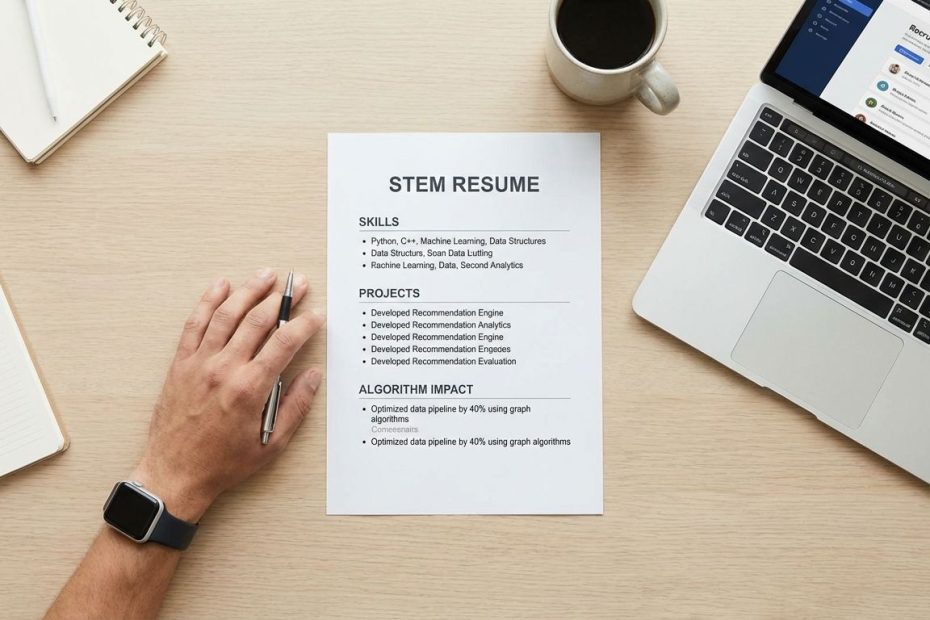
Your STEM resume wins interviews when it makes two audiences say “yes” fast: an ATS looking for clean, parseable keywords, and a recruiter scanning for credibility in under 10 seconds. Structure your resume so the top third shows role fit, skill fit, and proof, then let the rest confirm depth without forcing anyone to hunt.
You’re about to implement a layout that reads cleanly in applicant tracking systems, aligns with how recruiters visually skim, and showcases algorithmic impact in a way hiring teams trust. You’ll leave with a practical ordering for new grad and experienced resumes, a formatting standard that avoids parsing failures, and bullet-writing patterns that turn technical work into a hiring signal.
What’s The Best STEM Resume Structure For Software/Algorithms Roles (New Grad Vs Experienced)?
Use a single-column, reverse-chronological resume with standard headings and a top-heavy first page. Recruiters do not “study” resumes on the first pass, they skim for quick confirmation that you match the role, the level, and the problem domain. An eye-tracking study summarized by HR Dive reports recruiters spend an average of 7.4 seconds on an initial screen, and simple layouts with clear headings and bullets perform best.
That reality changes how you should allocate space. Your top third must answer: what role you want, what technical stack you can execute in, and what outcomes you delivered. If a recruiter needs to scroll or decode design choices to locate those answers, you lose the fast pass and get re-queued behind clearer candidates.
New Grad Structure (When Experience Is Light): put skills and proof close to the top. The default order that performs well for algorithm-heavy SWE, data, and ML screening is: Header, optional 1–2 line summary (only if it adds signal), Skills, Projects, Experience, Education. This ordering lets a reviewer see your languages, core CS strengths, and concrete builds before they judge your limited work history.
Early-Career And Experienced Structure (When Experience Carries The Story): lead with Experience, then Skills, then Education, with Projects only if they add unique relevance. Hiring teams trust shipped work and scoped responsibilities, so the resume should surface that first. A good experienced ordering is: Header, Experience, Skills, Education, Projects (optional), Publications/Awards (optional).
Keep The Visual Grammar Predictable: consistent title formatting, consistent date formatting, consistent bullet formatting. The HR Dive summary of the eye-tracking study notes E- and F-pattern reading tendencies, and resumes do well when they use bold titles and bulleted accomplishments. Predictable structure supports those scan patterns and reduces reader friction.
Algorithm Roles Need Proof Placement: if you’re targeting back-end, infra, quant, ML, or search/ranking roles, place at least one “algorithm-adjacent” proof point in the first half of page one. That can be a performance win, complexity reduction, scaling result, or model metric lift, as long as it is measurable and technically specific.
How Do You Make Your Resume ATS-Friendly Without Making It Ugly For Recruiters?
ATS-friendly and recruiter-friendly overlap more than people admit, because both reward clarity. A recruiter wants fast pattern recognition, and most ATS tools want clean text extraction and predictable headings. Your job is to eliminate elements that break parsing or slow scanning: columns, text boxes, graphics, icons, and decorative dividers that split content into fragments.
Stick to a single column with left-aligned text and a simple hierarchy. Use bold for job titles, company names, and section headers, then rely on whitespace rather than heavy lines or shapes. The HR Dive summary of the Ladders eye-tracking findings highlights that clutter, multiple columns, long sentences, and missing headers reduce performance, and that clear sections with headings and bullets help resumes succeed.
ATS-Safe Formatting That Still Looks Sharp:
- One column, standard margins, consistent spacing between roles.
- Standard section names: Skills, Experience, Projects, Education.
- No tables, no text boxes, no two-column skills blocks.
- No header/footer dependence for critical data like phone, email, or links.
- Bullets capped at 1–2 lines for the first pass, with technical detail compressed into nouns and metrics.
Use The Copy-Paste Test: copy your resume text from the PDF/DOCX into a plain text editor. If dates jump lines, company names separate from titles, or bullets merge into paragraphs, the ATS import is likely to misread you. Fix the formatting until the text remains intact when stripped of styling.
Design Doesn’t Beat Evidence: recruiters reward readability, not decoration. A visually “creative” resume can still work in design fields, but algorithms and STEM hiring favors directness. You’re optimizing for fast comprehension, easy comparison against the job posting, and strong evidence density per line.
Should You Submit Your Resume As PDF Or DOCX For ATS In 2025–2026?
Submit the file type that the portal requests, and default to the format that preserves parsing in that environment. Many ATS platforms can handle PDFs, yet parsing failures still happen when the PDF was generated from a design tool, includes text boxes, or embeds content as images. In practice, a clean DOCX is often the safest for automated parsing, and a clean text-based PDF is often preferred when emailing a recruiter or hiring manager.
Decision rule you can implement without overthinking it: if the application portal explicitly supports DOCX, upload DOCX. If it says PDF only, upload a text-based PDF exported from Word or Google Docs with selectable text. If you’re sending the resume directly to a human contact, send PDF for consistent rendering, and keep a DOCX ready if they ask for an editable version.
Do not let format debate distract from the bigger win: content clarity and proof density. A perfectly formatted file with vague bullets still underperforms. An average-looking file with strong outcomes, relevant keywords, and clean structure gets interviews.
PDF Pitfalls To Avoid:
- Scanned PDFs, image-based exports, and “print to PDF” outputs that flatten text.
- Text embedded inside shapes, columns, or design elements.
- Icons standing in for words, since ATS needs literal text.
- Hyperlinks that replace visible URLs entirely; show clean link text.
DOCX Pitfalls To Avoid:
- Tables used to align dates and titles.
- Auto-formatting that changes bullet indentation across systems.
- Odd fonts that render poorly when converted by a portal.
What Keywords And Skills Do Recruiters And ATS Actually Screen For In STEM Resumes?
Recruiters screen for skills that map directly to job requirements, and the market trend favors skills evidence over proxy signals. NACE reported in January 2024 that nearly 90% of employers look for evidence of problem-solving on resumes and nearly 80% look for teamwork, with additional emphasis on communication and other job-ready competencies. This matters for STEM roles because hiring teams are not only evaluating your coding ability, they are evaluating how you operate inside real systems, with real constraints, and real stakeholders.
Skills-based hiring is also becoming more common in entry-level pipelines. NACE reported that close to two-thirds (64.8%) of employers surveyed use skills-based hiring practices for new entry-level hires, and a 2026 update reported 70% using skills-based hiring, with screening and interviewing being the stages where it shows up most. That tells you exactly how to structure your resume: list skills, then prove them quickly, then reinforce them across roles and projects.
Build Two Keyword Layers: tools and outcomes. Tools are languages, frameworks, cloud, databases, and dev workflow. Outcomes are what those tools produced: latency reduction, throughput increase, model lift, cost savings, reliability improvements, fraud reduction, ranking gains, or pipeline speed-ups. A recruiter and ATS can match tools, yet hiring managers decide on outcomes.
Common STEM Keyword Buckets That Convert:
- Core CS: data structures, algorithms, complexity, concurrency, operating systems.
- Back End: APIs, microservices, distributed systems, caching, queues, databases.
- Data: SQL, ETL, orchestration, warehousing, data quality, governance.
- ML/AI: feature engineering, evaluation, model deployment, monitoring, prompt engineering (role-dependent).
- Infra: AWS/GCP/Azure, Docker, Kubernetes, CI/CD, observability, incident response.
- Security: authn/authz, threat modeling, vulnerability remediation, secure coding.
Match The Job Description Verb Tense And Naming: if the posting says “Golang,” do not hide behind “Go.” If it says “PostgreSQL,” do not only say “SQL.” Use the employer’s naming for the first pass, then add your broader label in parentheses when it helps.
Rising Skills Still Need Proof: LinkedIn’s Skills on the Rise reporting, covered by CNBC in March 2025, listed AI literacy and LLM development/application among the top fast-growing skills. Those keywords help only when you tie them to real work: measurable productivity gains, safe deployments, evaluation methods, or documented improvements to developer velocity.
How Do You Write Impact-Focused Bullets For Technical Work (With Metrics)?
Write bullets that start with the outcome, then lock it to a metric, then show the method. A recruiter reads left to right, and a hiring manager scans for “what changed” before caring how you changed it. When you lead with the result, you earn attention and buy enough time for the technical detail to matter.
Use an XYZ-style pattern that forces clarity: what you achieved (X), how it was measured (Y), and what you did (Z). This keeps you honest and keeps bullets short. It also prevents the most common STEM resume failure: listing tasks that sound busy but do not show value.
Metrics That Work In Algorithm And Systems Hiring:
- p50/p95/p99 latency, throughput, QPS, tail performance.
- runtime reduction, memory reduction, complexity reduction.
- cost per request, cloud spend, compute hours saved.
- error rate, incident count reduction, SLO compliance.
- ranking metrics (NDCG, MAP), model metrics (AUC, F1), calibration, drift rates.
- data freshness, pipeline duration, job failure rate, backfill time.
How You Get Numbers Without Guessing: pull from dashboards, logs, issue trackers, experiment reports, postmortems, or PR descriptions. If internal numbers are sensitive, publish deltas and relative improvements rather than absolute volumes. A bullet reading “reduced p95 latency 28%” still communicates value without revealing traffic.
Bullet Construction Rules That Hold Up In Review Meetings:
- One bullet, one win. Split mixed wins into separate lines.
- Use strong verbs: built, shipped, optimized, reduced, automated, migrated, stabilized, implemented.
- Put the metric early, and keep the method precise but compact.
- Avoid long sentences, HR Dive’s eye-tracking summary notes long sentences reduce readability.
Make Algorithms Concrete: “improved an algorithm” is not a hiring signal. “replaced O(n²) matching with hashing and reduced runtime 62% on a 10M-row dataset” is a hiring signal. When you write algorithm bullets, include the bottleneck, the method, and the measured win.
Do Projects Still Matter After Internships Or Full-Time Experience, And Where Should They Go?
Projects matter when they add signal you do not already have in your job history. Early on, projects are your fastest way to prove practical skill: you build, deploy, measure, and document without waiting for a company to grant you scope. Later, projects shift from “proof of ability” to “proof of specialization,” and they stay only when they support the exact role you’re targeting.
Placement should follow what the hiring team trusts most for your level. If you have limited professional experience, place Projects above Experience and treat projects like mini-jobs with measurable outcomes. If you have multiple internships or full-time experience, keep 1–2 highly relevant projects and move them below Experience, or fold them into Experience if the project was executed inside a role.
Project Signals That Recruiters Respect:
- Deployed systems with uptime, monitoring, and real users.
- Benchmarks, performance tests, or reproducible evaluations.
- Open-source contributions with meaningful PRs and reviews.
- Clear README, architecture diagram, and a short demo link.
- Competitions or research with verifiable results and methods.
Project Smells That Get Skipped:
- Tutorial clones with no changes and no results.
- Buzzword stacks with no explanation of decisions.
- Three long paragraphs describing what the app “does” without metrics.
- Unmaintained repos that look abandoned.
When projects matter, make them recruiter-readable. Put the tech stack on the same line as the project name, then add 2–3 bullets that show measurable outcomes, algorithmic choices, or systems tradeoffs. If a recruiter cannot understand the value in a 10-second skim, the project does not help you in a competitive pipeline.
Best STEM Resume Structure For Algorithms Roles
- Use one column, reverse-chronological order
- Put Skills + proof in the top third
- Lead with Experience (experienced) or Projects (new grad)
- Write metric-led bullets tied to job keywords
Go Build The Resume Recruiters Can Read Fast
Structure wins interviews when it turns your background into fast, verifiable signal: clear headings, one-column formatting, and proof placed where the first skim lands. Make keywords work by pairing them with evidence in bullets, and use metrics that hiring teams recognize for algorithm and systems work. Submit the format the portal requests, keep a clean DOCX ready for parsing, and keep a clean PDF ready for human sharing. Treat projects as a strategic asset that stays only when it adds role-specific proof beyond your job history. Then update your resume like a product: tailor the top third to each role, measure which version gets callbacks, and keep tightening until the first page tells the whole story.
References
- HR Dive: Eye tracking study shows recruiters look at resumes for 7 seconds
- NACE: The Key Attributes Employers Are Looking for on Graduates’ Resumes (Jan 23, 2024)
- NACE: Nearly Two-Thirds of Employers Use Skills-based Hiring Practices for New Entry-level Hires (Nov 7, 2024)
- NACE: Almost Two-thirds of Employers Use Skills-based Hiring to Help Identify Job Candidates (May 19, 2025)
- NACE: Employer Use of Skills-Based Hiring Practices Grows (Jan 12, 2026)
- CNBC: Fast-growing skills employers want to see on your resume (LinkedIn report) (Mar 19, 2025)
- freeCodeCamp/Medium: How to write a killer Software Engineering résumé
- TalentTuner: ATS Resume Format Guide 2025
- PassTheScan: ATS Myths (2025)
- WisGrowth: PDF vs DOCX for ATS
- Reddit: Projects vs experience (discussion thread)
- Reddit: When to remove projects section (discussion thread)
- Reddit: PDF vs DOCX for resumes (discussion thread)
- Reddit: PDF vs Word for ATS (discussion thread)
- LinkedIn post: Why PDF is the best format for resumes (Jennifer P.)

Chrysilios Chrysiliou is a commercial real estate executive at RDPH Properties, Inc. with a diverse background in aviation and entrepreneurship. A former Greek Air Force Academy graduate, flight instructor, and flight school co-owner, he now leverages decades of strategic leadership to identify and develop high-value real estate opportunities.