
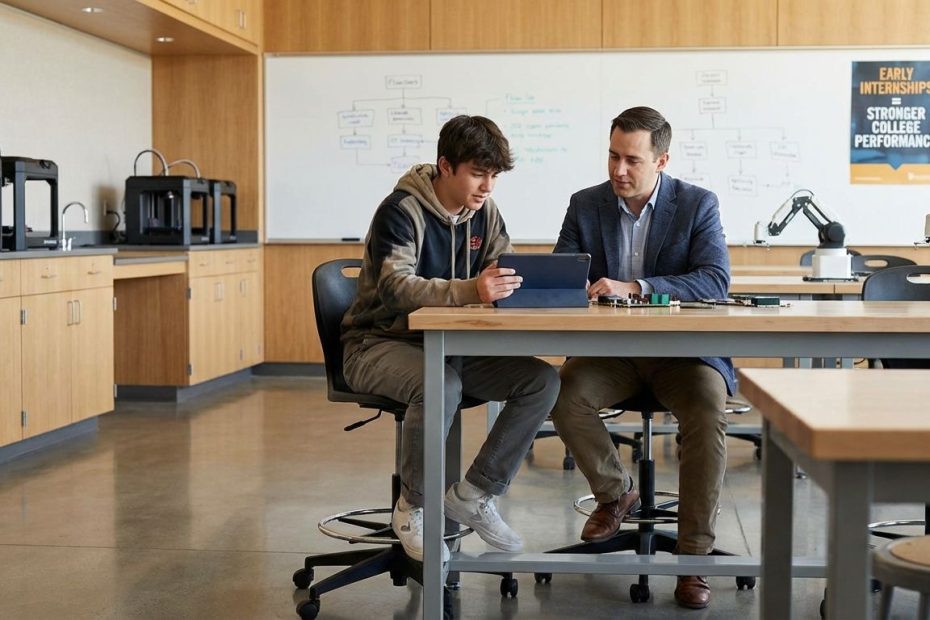
High school STEM internships can set you up to outperform peers in college, not by “magically raising GPA,” but by accelerating your technical fluency, tightening your study habits, and giving you early clarity on majors, labs, and career paths. When that head start shows up in college, it usually looks like stronger course performance in advanced STEM classes, faster access to research, and better execution on team projects and internships.
This article breaks down what the evidence actually supports, what “outperformed” should mean if you want to stay precise, and how you can build a high-quality internship experience in high school that continues paying dividends through college. You’ll also get practical guidance on access, credibility, and what separates signal from résumé noise.
Do High School STEM Internships Actually Improve College Grades And Academic Performance?
If the headline claim is “interned in high school, got better college grades,” the honest answer is that most large studies don’t measure high school internships cleanly enough to make that direct statement with confidence. A lot of datasets track college internships, undergraduate research, or broader high school career pathways, then connect those to postsecondary outcomes. That’s still useful, it just means the wording needs discipline.
The strongest GPA-focused anchor in the research base comes from undergraduate internship participation. A multi-institution longitudinal study summarized by the Council of Independent Colleges’ research digest reported that internship participation during college was associated with roughly a one-quarter standard deviation increase in fourth-year GPA. That’s not “life-changing,” yet it’s a real, measurable academic lift in a domain where huge effect sizes are rare.
So where does that leave high school STEM internships? Treat them as an upstream accelerator. A strong high school internship can build the learning behaviors and technical stamina that make you perform better once college coursework turns into multi-step problem sets, lab reports, and project-based grading. That pathway is plausible and consistent with what high-quality work-based learning programs aim to teach, yet it is not the same as having a clean causal estimate that says “high school internship directly raised college GPA by X.”
What Does The Research Say About Internships Or Work-Based Learning Improving College Enrollment, Persistence, Or Completion?
If “outperformed peers” is defined as getting into college, staying in, and earning a credential, the evidence base gets stronger because career-connected learning is measured more often at the secondary level. Many studies examine CTE participation, concentrator status, and work-based learning participation rather than informal, self-arranged lab internships. That distinction matters, since structured programs typically have clearer definitions, oversight, and data trails.
A 2021 impact study from REL Central examined CTE course sequences in Nebraska and South Dakota and found that CTE concentrators were 7 percentage points more likely to graduate high school on time and 10 percentage points more likely to enroll in postsecondary education within two years. The same study reported a 3 percentage point increase in earning a postsecondary award within five years, with differences by credential type. Those are concrete outcomes that map to “outperforming peers” in a way that’s defensible.
A systematic review released by American Institutes for Research in May 2024 also reported positive impacts of CTE on several high school outcomes and employability, with more mixed or limited impacts on four-year college progression and degree completion across the studies they reviewed. Read that carefully and it becomes a useful guardrail: career pathways help, yet they do not automatically translate into four-year completion gains across every setting.
How Common Are High School Internships, And Which Students Get Them?
Participation is rising in places that measure it and invest in it, and access remains uneven across geography and school resources. That unevenness is one reason high school internships correlate with later success: part of the relationship is skill-building, and part of it is opportunity concentration. If an article ignores access, readers end up blaming themselves for a system-level supply issue.
Iowa is a clean example of rapid scale because the state publicly reported participation. On September 15, 2025, the Iowa Department of Education reported that 45% of seniors in the class of 2025 achieved at least one work-based learning experience, up from 31.7% for the class of 2024 and 25.5% for the class of 2023. When a state defines the measure, tracks it, and prioritizes it, the participation curve can move fast.
Washington state’s longitudinal CTE study, published September 2025, reinforces the access gap story in a different way. It reports that rural, low-income, and small schools offered fewer CTE pathways on average, even while statewide CTE participation was very high and growing. That pattern is a practical warning for students: if the local ecosystem is thin, the strategy needs to shift toward school-supported programs, remote project work, community college options, or structured camps rather than expecting a university lab to absorb minors on demand.
What “Outperformed” Looks Like In College: GPA, Confidence, Internships, Or Early Career Salary?
“Outperformed” is a vague word unless it’s pinned to metrics. In STEM, the metrics that move first are often not GPA. The early, obvious wins tend to show up as faster onboarding into research groups, better performance in lab-based courses, and stronger execution in team deliverables where process matters as much as raw intelligence.
Career outcomes also provide clearer measurement than college grades in many datasets. A NACE study released May 14, 2025 reported that Gen Z professionals who participated in experiential learning during college had higher average reported salaries ($59,059 vs. $44,048), along with higher reported career satisfaction and “faster-than-expected” career progress rates. That’s not a high school internship statistic, yet it clarifies why early exposure matters: once you learn how experiential learning works, you tend to keep using it, and compounding happens.
Competency development is another way “outperformance” manifests, especially in the first two years of college when students are learning how to operate. NACE’s earlier student survey reporting showed large self-reported gains in professionalism/work ethic, teamwork, and communication from internships or co-ops. In practical college terms, those gains translate into higher-quality lab notebook habits, cleaner version control and documentation, more effective office-hour questions, and better group project leadership.
Why Would A High School STEM Internship Help You Outperform Peers Once You’re In College?
High school internships help when they compress the learning curve on the parts of STEM that colleges often assume you’ll figure out through trial and error. That includes how to ask for help without wasting someone’s time, how to document work so it’s reusable, and how to recover from failure fast. Those behaviors decide who thrives when courses stop being “learn and repeat” and start being “design, test, debug, explain.”
High-quality work-based learning is built around three elements that align well with college performance: alignment between classroom learning and workplace tasks, application of academic and technical skills in real work settings, and support from mentors. When those elements are present, the internship is not just exposure, it becomes training in how to learn under real constraints. That learning style transfers cleanly into demanding STEM courses.
Motivation and identity also matter, especially for students who have not seen themselves as “research people” yet. A 2024 study on high school coding, data science, and deep learning camps reported increased confidence in coding and noted that 68.6% of participants expressed interest in AI and data science careers. Confidence is not a grade, yet it shapes persistence, course selection, and willingness to pursue competitive labs and internships once on campus.
How Do You Actually Get High School Research Internships In STEM, Especially Without Connections?
A workable strategy starts by accepting an uncomfortable truth: cold outreach works sometimes, and it fails often. Many labs have restrictions on minors, limited capacity, and no incentive to respond to generic emails. Treat outreach like a pipeline with conversion rates, not like a single all-or-nothing request.
The first reliable path is school-run or district-run programs that already have legal and supervision processes in place. The second is structured external programs, including university summer research programs, workforce programs, and paid youth apprenticeship or internship partnerships. The third is direct outreach to labs and companies, where your goal should be to reduce risk for the host by offering a tightly scoped, low-supervision contribution.
Community threads show the pattern repeatedly: response rates are low, and “warm introductions” change everything. In a June 2025 discussion about interning in a university lab, one student reported that many professors did not respond or did not prefer working with high schoolers, and that meeting a professor at an event led to an invitation. That matches real operating reality: trust and reduced uncertainty drive yes decisions, not raw enthusiasm.
When access is limited, build substitutes that still develop the same skills. Data analysis projects, open-source contributions, hardware builds with measured outputs, and independent research with a teacher sponsor can produce artifacts that make later internship applications stronger. The goal is not the title “intern,” it’s the evidence of competence and follow-through.
Are High School Internships “Real,” Or Are Admissions And Universities Skeptical Of Them?
Skepticism is not automatic, yet vague internships get discounted fast. When a reader says “interned at a lab,” the next question from any serious evaluator is, “What did you deliver, and who can verify it?” If the internship produces no artifacts, no methods, no tools used, and no clear scope, it reads like a label, not an experience.
Credibility markers are straightforward. You want a defined role, documented hours or milestones, a named supervisor, and outputs you can show without revealing sensitive information. Outputs can include a poster, a GitHub repository, a data dictionary, a lab methods write-up, a literature matrix, a test plan, or a documented pipeline. Even when you can’t share raw data, you can almost always share process, tooling, and what you learned to measure and improve.
Quality standards from work-based learning guidance point in the same direction. When classroom learning aligns to workplace tasks, when skills get applied in a real setting, and when mentoring exists, the experience becomes legible to outsiders. That legibility is what protects you from skepticism and helps the internship translate into college performance gains.
Do High School STEM Internships Really Help Students Succeed in College?
- They accelerate lab and technical readiness, making advanced coursework easier
- They build stronger study and work habits that transfer into college projects
- They clarify majors and research interests earlier, reducing trial-and-error
- They improve execution on team projects and internships, not just resumes.
Turn Early Experience Into A College Advantage That Keeps Compounding
A high school STEM internship matters most when it produces repeatable habits: disciplined documentation, weekly goal-setting, and comfort operating under ambiguity. Pair that with measurable outputs, and you enter college ready to perform in labs and advanced coursework, not just attend classes. Keep the definition of “outperformed” grounded in outcomes you can show, stronger course performance, faster research onboarding, better teamwork, and a clearer internship pipeline. If access is limited, build artifacts through structured programs or independent projects that prove capability. Then use college to stack the next experience on top of the first, since compounding is where the real separation happens.

Chrysilios Chrysiliou is a commercial real estate executive at RDPH Properties, Inc. with a diverse background in aviation and entrepreneurship. A former Greek Air Force Academy graduate, flight instructor, and flight school co-owner, he now leverages decades of strategic leadership to identify and develop high-value real estate opportunities.