
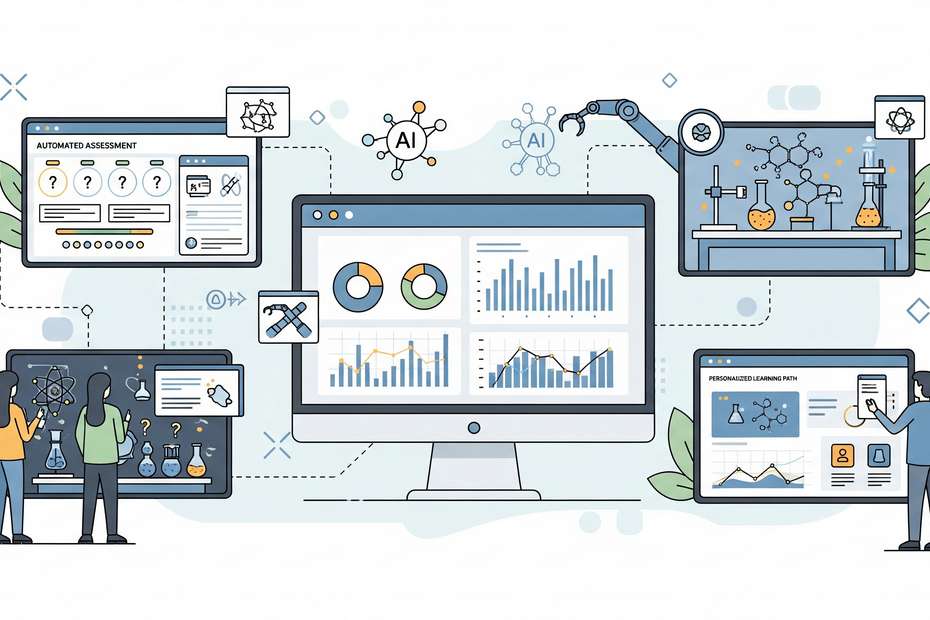
AI tools are reshaping STEM education by personalizing learning, automating feedback, and providing virtual experimentation opportunities that expand access and accelerate student mastery.
You gain a clear advantage by adopting AI-powered systems that streamline teaching, identify learning gaps, and offer scalable solutions. This article explains how AI enhances STEM classrooms, the challenges you must manage, and the strategies that ensure measurable impact on student outcomes.
What is the role of AI in STEM education today?
AI serves as a teaching assistant, continuously analyzing student data to deliver customized learning paths. It adapts lessons to match pace, strengths, and weaknesses.
Tools like intelligent tutoring systems provide immediate corrective feedback in math, science, and coding assignments. This keeps students engaged while ensuring errors are addressed before habits set in.
As an educator, you no longer rely on a one-size-fits-all curriculum. Instead, AI helps you deliver differentiated learning without increasing your workload.
How do adaptive platforms improve student outcomes?
Adaptive platforms monitor performance and recommend next steps based on data. Struggling students receive reinforcement, while advanced learners progress without unnecessary delays.
Systems such as Carnegie Learning in math or ALEKS for science demonstrate higher retention rates when adaptive features are implemented. Students build confidence by progressing at a pace aligned with their ability.
The impact is tangible: improved test scores, reduced dropout rates, and more consistent long-term retention.
What is the impact of virtual labs and simulations?
Virtual labs allow students to perform experiments anytime, anywhere, without physical resource limitations. Complex subjects like physics or chemistry become interactive and safe to explore.
Simulation software replicates real-world engineering problems, from aerodynamics to chemical reactions. Students can adjust variables, test hypotheses, and observe instant outcomes.
This not only reduces costs but also enhances equity, giving students without access to expensive equipment a comparable learning experience.
How does AI improve assessments and feedback?
AI automates repetitive grading, freeing your time for higher-value teaching. It instantly evaluates assignments and generates detailed analytics on performance trends.
Feedback is delivered in real time, enabling students to act immediately. This prevents delays that often lead to frustration or disengagement.
Teachers also benefit from insights into class-wide patterns. You identify common areas of struggle and adjust lesson plans before problems escalate.
What challenges and risks should you anticipate?
AI in STEM education carries risks if not carefully managed. Overreliance on tools can lead students to bypass critical thinking and problem-solving practice.
Data privacy remains a concern, as many platforms collect sensitive student information. You must ensure compliance with regulations and transparency with stakeholders.
Bias in algorithms can also disadvantage certain groups of learners if not tested thoroughly. Regular audits and teacher oversight mitigate these risks.
How can you integrate AI tools successfully?
Adoption requires a phased approach. Start with a pilot program to evaluate tool effectiveness in one subject or grade level.
Provide professional development for teachers so they understand how to interpret AI-generated insights and manage classroom integration. Students also need digital literacy training to use AI responsibly.
Combine AI tools with traditional teaching methods. For example, use virtual labs alongside physical ones, or pair AI-driven assessments with teacher-reviewed essays to maintain balance.
What evidence supports the use of AI in STEM?
Research consistently shows improved engagement and outcomes when AI is integrated thoughtfully. Adaptive learning platforms demonstrate measurable gains in math and science proficiency.
Studies highlight stronger performance when virtual labs complement traditional methods. Students gain deeper conceptual understanding by experimenting freely without physical limitations.
Institutions that adopt AI tools report more efficient teaching workflows and higher student satisfaction scores, reinforcing the case for strategic implementation.
What trends will shape the future of STEM education with AI?
Expect human-in-the-loop systems where students critique or refine AI responses, fostering meta-cognitive skills.
AI literacy will become a standard part of STEM education. Students will not only use AI tools but also understand their design, strengths, and limitations.
Greater collaboration between educators and AI developers will result in platforms that better align with academic standards and ethical guidelines.
Key Ways AI Is Reshaping STEM Education
- Personalizes learning paths with adaptive platforms
- Provides virtual labs and simulations for experiments
- Automates grading and delivers real-time feedback
- Improves engagement and long-term performance
In Conclusion
AI tools are permanently changing how STEM is taught and learned. By implementing adaptive platforms, virtual labs, and real-time assessment systems, you create personalized and scalable education models. Success requires careful oversight, teacher training, and ethical safeguards, but the payoff is stronger engagement, deeper understanding, and better outcomes for students.

Chrysilios Chrysiliou is a commercial real estate executive at RDPH Properties, Inc. with a diverse background in aviation and entrepreneurship. A former Greek Air Force Academy graduate, flight instructor, and flight school co-owner, he now leverages decades of strategic leadership to identify and develop high-value real estate opportunities.