
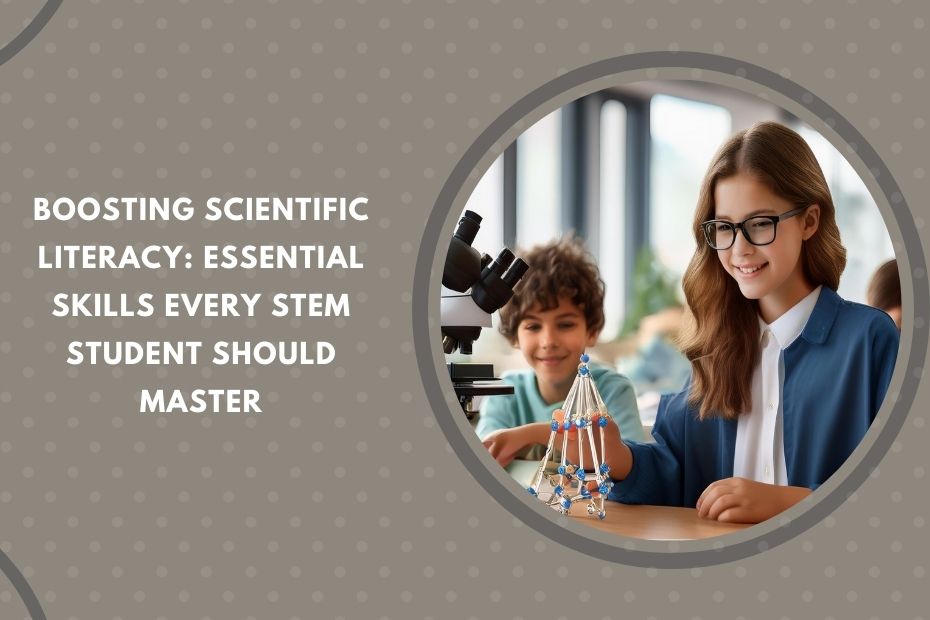
Scientific literacy is more than just understanding basic scientific facts; it’s the ability to think critically, analyze data, solve complex problems, and communicate findings effectively. For STEM students, developing strong scientific literacy is essential— for academic success and navigating real-world challenges in an increasingly science-driven world. The right combination of skills can open doors to exciting opportunities in research, innovation, and industry. This article explores key skills every STEM student should master to build their scientific literacy and thrive in their chosen fields.
Critical Thinking: The Foundation of Scientific Literacy
Critical thinking is at the heart of all scientific endeavors. It involves questioning assumptions, analyzing evidence, and making logical conclusions. In STEM fields, this skill is crucial for problem-solving, conducting experiments, and interpreting results. A student who can approach problems critically will excel academically and contribute meaningfully to scientific advancements.
One effective way to develop critical thinking is by engaging in activities that require deep analysis, such as case studies or research-based projects. Tackling open-ended questions forces students to evaluate multiple solutions and defend their conclusions with evidence. This skill becomes invaluable when working on complex problems where the solution isn’t immediately obvious.
Research and Information Literacy: Finding and Evaluating Scientific Data
In STEM disciplines, research plays a vital role in advancing knowledge. To build scientific literacy, students must become proficient in locating, evaluating, and applying scientific information. This includes understanding how to access peer-reviewed journals, discerning credible sources from unreliable ones, and synthesizing information from various studies.
STEM students should also learn how to use online research databases and citation management tools effectively. Familiarity with platforms like PubMed, IEEE Xplore, and Google Scholar allows students to stay updated with the latest developments in their fields. Learning how to critically read scientific papers, extract key information, and identify research gaps enhances a student’s ability to contribute to ongoing discussions and innovations.
Quantitative Reasoning: Interpreting and Analyzing Data
Quantitative reasoning refers to the ability to work with numerical data, identify patterns, and draw meaningful conclusions. This skill is indispensable in fields like engineering, physics, biology, and computer science, where data-driven decision-making is a daily requirement.
STEM students often encounter quantitative reasoning through courses in statistics, calculus, and data analysis. By practicing real-world applications, such as interpreting experimental results or working on data visualization projects, students can strengthen their ability to make informed decisions based on numerical information. Mastery of this skill ensures that students can handle tasks such as statistical modeling, hypothesis testing, and predictive analysis with confidence.
Communication: Conveying Complex Ideas Clearly
Effective communication is often overlooked in STEM education, yet it is a vital component of scientific literacy. STEM professionals are frequently required to present their findings to both technical and non-technical audiences. Being able to explain complex concepts in a clear and concise manner ensures that their work has a broader impact.
Students can improve their communication skills by writing research reports, delivering presentations, and participating in group discussions. Whether it’s through technical writing, visual aids, or oral communication, the ability to convey information effectively helps students collaborate with peers and engage with the public. Clear communication also plays a key role in securing grants, publishing research, and influencing policy decisions.
Collaboration and Teamwork: Working Towards Common Goals
Science and technology thrive on collaboration. In professional settings, STEM experts often work in multidisciplinary teams, where each member brings a unique skill set to solve complex problems. Developing the ability to work well with others is, therefore, an essential skill for STEM students.
Collaborative projects, whether in a lab or classroom, provide valuable opportunities to practice teamwork. Students learn to divide tasks, manage conflicts, and leverage each other’s strengths to achieve a common goal. Strong teamwork skills are beneficial during academic projects and highly valued by employers across industries.
Technological Proficiency: Staying Current with Tools and Techniques
Technological proficiency is critical for STEM students, as advances in technology continuously reshape the way scientific work is conducted. Familiarity with software tools, programming languages, and laboratory equipment is often required for both academic and professional success.
Students should seek to gain hands-on experience with tools relevant to their fields. For instance, aspiring data scientists can benefit from learning Python or R, while engineering students may need to master CAD software. Staying updated with emerging technologies ensures that students remain competitive and adaptable in a fast-paced industry.
Ethical Reasoning: Navigating Moral Challenges in Science
Ethical reasoning is a key component of scientific literacy. STEM students must understand the ethical implications of their work, from ensuring the integrity of data to considering the societal impact of new technologies. Ethical dilemmas are common in fields like biotechnology, artificial intelligence, and environmental science, where advancements can have far-reaching consequences.
Understanding ethical principles helps students make responsible decisions, whether they are conducting research or developing new technologies. Courses on research ethics and professional responsibility can provide a strong foundation, but students should also be encouraged to engage in discussions about real-world ethical issues.
Lifelong Learning: Embracing Continuous Growth
Science and technology are fields that never stand still. New discoveries, techniques, and tools emerge regularly, making lifelong learning an essential skill for any STEM professional. Students who adopt a mindset of continuous growth are better prepared to adapt to changes and seize new opportunities throughout their careers.
Lifelong learning can take many forms, including enrolling in advanced courses, attending industry conferences, or participating in online learning platforms. By staying curious and open to new knowledge, students can ensure they remain at the forefront of their chosen fields.
Key Tips for Boosting Scientific Literacy
- Develop critical thinking by solving complex problems.
- Improve research skills using academic databases.
- Practice quantitative reasoning with data analysis tasks.
- Build communication skills through reports and presentations.
- Strengthen collaboration via teamwork projects.
- Stay updated with technology and ethical considerations.
In Conclusion
Building scientific literacy requires mastering a combination of skills that go beyond understanding basic scientific concepts. From critical thinking and research to communication and technological proficiency, these essential skills equip STEM students to excel in their academic pursuits and contribute meaningfully to scientific progress. By focusing on these key areas, students can boost their scientific literacy and prepare for a successful career in a world increasingly driven by science and technology.

Chrysilios Chrysiliou is a commercial real estate executive at RDPH Properties, Inc. with a diverse background in aviation and entrepreneurship. A former Greek Air Force Academy graduate, flight instructor, and flight school co-owner, he now leverages decades of strategic leadership to identify and develop high-value real estate opportunities.