
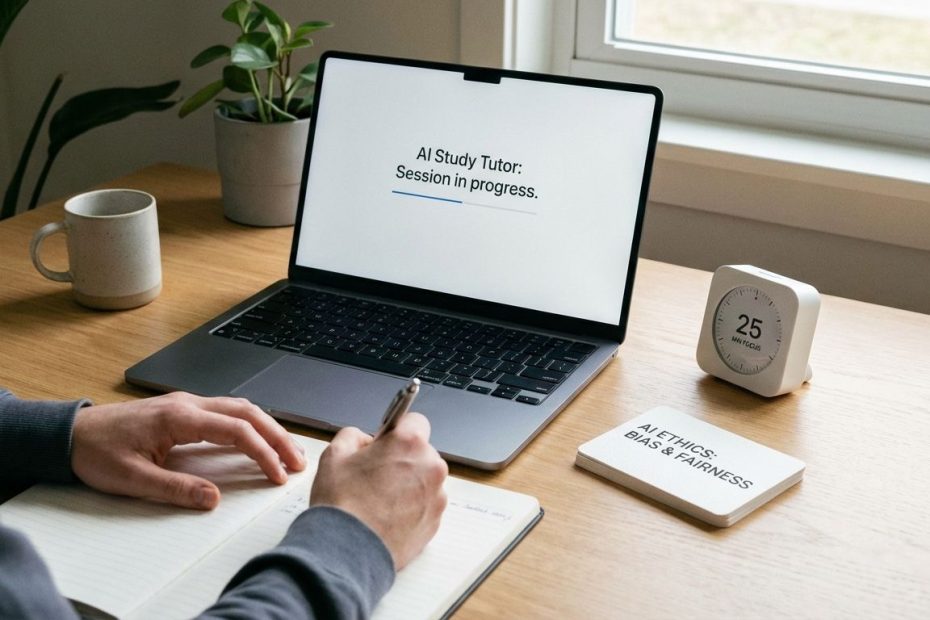
AI supercharges your study habits when you use it to force retrieval, tighten your notes into testable prompts, and keep your daily plan realistic under time pressure. Used well, it becomes a coaching layer that turns reading into recall, and recall into exam-ready performance.
You can use the same tools most students already touch, and set them up to produce flashcards, quizzes, and schedules that match how memory works. The goal is simple: walk away with a repeatable workflow that produces measurable progress every week, not prettier notes.
Way 1: Use AI As A Tutor (Without It Just Giving You The Answer)
If AI “solves” everything, you get speed without skill. If AI tutors you, you get durable knowledge you can retrieve under exam conditions, and that is the difference that matters.
Start by controlling the interaction. You want the model to ask questions, probe gaps, and react to your attempts. When the tool plays tutor, you stay in the work, and the work stays in your brain.
Chat-style tutoring is also aligned with where mainstream products are heading. Reporting on OpenAI’s “study mode” pointed to an experience designed to guide you through material rather than hand over a final answer, which matches what disciplined learners already do manually: attempt first, get targeted feedback second.
How to run a high-output tutoring loop: write your first attempt, even if it is messy. Then paste it and ask for a coaching sequence: clarification questions, a single hint, then a re-test. Keep the loop short so it stays intense and measurable.
Prompts You Can Copy
- Socratic tutoring: “Act as my tutor. Do not solve. Ask 5 questions that lead me to the answer. After I respond, give one hint max. Then ask me to explain the full solution in my own words.”
- Error correction: “Here is my answer. Identify the first wrong step, explain why it is wrong in two sentences, then ask me to correct it.”
- Exam simulation: “Quiz me with 10 questions from this topic. Mix recall, application, and one tricky misconception check. After each answer, grade it and ask a follow-up.”
Quality control: require the AI to label which concept each question targets. If the label feels vague, the question is usually vague too. Tight questions produce tight recall.
What to measure: track “time to correct answer” and “miss type.” Your goal is to see misses shift from conceptual to minor details, and then disappear. That progression is how strong study systems behave in the real world.
Way 2: Turn Notes Into Anki-Ready Flashcards With AI Prompts That Stay Short
Flashcards work when each card tests one idea, and the answer is brief enough to recall cleanly. AI helps by converting raw notes into large volumes of cards quickly, but only if you constrain format and length.
Student communities consistently focus on “best prompt for flashcards” because the default output from general chat tools tends to be wordy, multi-part, and hard to review. In r/Anki threads, people share prompt patterns and workflows that push ChatGPT toward CSV or table outputs that import cleanly, with strict limits to prevent bloated cards.
Card rules that keep reviews fast:
- One fact or one relationship per card.
- Answer length cap: 12 words is a strong default.
- Avoid lists inside answers. Lists turn one card into five cards.
- Prefer cloze deletion when the material is dense and structured.
Prompts You Can Copy
- Basic Q/A CSV: “Create Anki flashcards from my text. Rules: 1 fact per card, answer ≤12 words, no lists, no multi-part answers. Output CSV with headers: Front,Back. Use only what is in my text. Text: [PASTE].”
- Cloze set: “Convert this into cloze deletions for Anki. Keep each cloze focused on one missing element. Output as a table: Cloze,Extra. Text: [PASTE].”
- Misconception cards: “From this text, generate 10 ‘trap’ questions that target common confusions. Keep answers ≤12 words. Output CSV: Front,Back.”
AI-assisted cleanup pass: after generating cards, run a second prompt: “Flag any cards that are ambiguous, too long, or test multiple ideas. Rewrite them to meet the rules.” This single step often cuts review time dramatically.
Export workflow reality: learners also discuss one-click export and quick import paths from ChatGPT outputs into Anki, showing that the practical friction point is not card creation, it is formatting and transfer. If the output is already CSV, importing becomes a routine action rather than a weekly project.
Way 3: Use AI-Generated Quizzes To Drive Retrieval Practice (The Skill That Moves Scores)
If one habit consistently separates high performers from busy strugglers, it is retrieval practice. Reading, highlighting, and rewriting notes can feel productive, yet they often produce weak recall under pressure. Quizzing forces you to pull knowledge out of memory, and that act strengthens future recall.
Evidence syntheses keep pointing the same direction: retrieval practice improves retention compared with restudying, and it can protect memory performance under stress in measurable ways. A meta-analysis published in Swiss Psychology Open examined retrieval practice and memory under stress, reinforcing the value of testing-style learning rather than passive review.
AI makes retrieval practice easier to sustain because it generates fresh questions on demand. That matters more than it sounds. Learners usually stop quizzing because writing questions takes time, and repeating the same small bank gets predictable. With AI, you can keep the difficulty calibrated and the question pool large.
Prompts You Can Copy
- Exam-style quiz: “Create 20 exam questions from this material: 12 short answer, 6 multiple choice with rationales, 2 application problems. Then wait for my answers. Grade strictly.”
- Spaced re-test: “Based on what I missed, generate a 10-question re-quiz focused only on those weak areas, with one ‘transfer’ question that applies the concept to a new scenario.”
- Oral recall: “Generate 15 rapid-fire questions I can answer out loud in under 10 seconds each. Keep them factual and unambiguous.”
Make quizzes do real diagnostic work: require the AI to tag each question by objective and difficulty. Then review your misses by tag. Patterns show up fast, and you can target the next study block instead of re-reading everything.
How this stays grounded in real adoption: survey reporting shows students are already using these tools at scale. Pew Research Center reported that 26% of U.S. teens ages 13–17 had used ChatGPT for schoolwork as of a survey fielded Sept. 18 to Oct. 10, 2024, up from 13% in 2023.
That adoption level means the edge comes from method, not access. Retrieval-first workflows produce the edge.
Way 4: Summarize Readings With AI Without Losing Key Details Or Trusting Wrong Output
Summaries are useful when they compress material into a structure you can test, not when they replace reading. The operational goal is accuracy, coverage, and speed. AI can help, but the workflow must reduce the chance of missing key claims or absorbing errors.
A practical method is “outline first, compress second.” Skim and create a rough outline with headings and bullet points. Then ask AI to tighten that outline into a study sheet, and convert it into questions.
Tools positioned around your own source set can support this style of studying. Coverage of Google’s NotebookLM highlighted product updates aimed at generating narrated overviews from documents you provide, reflecting the wider push toward source-grounded outputs rather than free-floating answers.
Prompts You Can Copy
- Structured summary: “Summarize this text into: (1) key terms, (2) main claims, (3) supporting evidence, (4) common confusions, (5) 10 quiz questions. Use only what appears in the text. Text: [PASTE].”
- Coverage check: “List 12 critical points from this text. For each point, paste the exact sentence that supports it.”
- Question-first reading aid: “Create 15 questions that this reading answers. Then provide a short answer key, each answer limited to one sentence.”
How to keep it reliable: force constraint and traceability. Ask for short outputs, demand quoted support for key points, and chunk long readings. When the model is pressured to stay inside the text, summaries become safer and more useful for study.
Turn summaries into memory: once the summary is clean, convert it into flashcards and a quiz. Summaries that do not convert into retrieval quickly turn into another passive artifact.
Way 5: Build A Study Plan You Will Follow Using Pomodoro Blocks And Daily Spaced Review
Most study plans fail for one reason: they ignore energy, attention span, and the need for frequent retrieval. A plan that looks good on Sunday collapses on Wednesday. AI helps by generating schedules that match your constraints, then adjusting them when real life happens.
Time boxing is one of the simplest levers. The Pomodoro method, or any structured work-rest cadence, can reduce drift and make study repeatable. A scoping review on the Pomodoro technique in anatomy learning contexts discussed outcomes tied to retention and study-session factors across included studies, supporting the idea that structured intervals can improve the study experience when applied consistently.
What a performance-focused plan includes:
- Daily spaced repetition (Anki or equivalent) that never gets skipped.
- Two focused blocks for new learning or problem sets.
- Cumulative re-testing every few days so old content stays alive.
- A built-in catch-up slot to prevent guilt spirals and overstuffed days.
Prompts You Can Copy
- Date-based schedule: “My exam is on [DATE]. I can study [X] minutes on weekdays and [Y] on weekends. Build a day-by-day plan with: 2 Pomodoro blocks/day, 20 minutes spaced repetition/day, 1 cumulative quiz every 3 days, 1 catch-up day/week. Output a table with dates.”
- Adaptive replanning: “Here is what I actually finished today: [LIST]. Update the next 72 hours only. Keep daily spaced repetition intact. Reduce scope without dropping the highest-yield topics.”
- Priority triage: “Given these topics and weights, rank them by likely exam payoff. Build a plan that allocates time by payoff and difficulty.”
Use AI like an operations manager: feed it constraints and force output that is executable. If the plan cannot be done in the stated minutes, reject it and demand a tighter version. The plan must match reality, or it will not survive the week.
Grounding this in student behavior: HEPI’s Student Generative AI Survey 2025 reported widespread use of AI tools among surveyed students, with strong growth year over year, reinforcing that the tool is common and the differentiator is disciplined use.
How Do You Use AI To Study Better?
- Generate quizzes and flashcards
- Force short answers, one idea per card
- Plan daily spaced review plus time-boxed blocks
- Use tutor prompts that require your attempt first
Put This Into Action This Week
Start with one upgrade that changes behavior fast: convert one lecture or chapter into clean Anki cards, then run a 20-question quiz that grades strictly. Add a daily plan with two time-boxed blocks and a non-negotiable spaced repetition window, and let AI re-plan the next 72 hours when the schedule slips. Use tutoring prompts that force your attempt before hints, and treat mistakes as data that drives the next quiz. Keep the workflow simple enough to run on a busy day, and results will compound across weeks instead of resetting every time motivation dips.
References
- Pew Research Center: About a quarter of U.S. teens have used ChatGPT for schoolwork – double the share in 2023 (Jan 15, 2025)
- The Verge: ChatGPT’s new AI study mode won’t just give you the answer
- Swiss Psychology Open: Does Retrieval Practice Protect Memory Against Stress? A Meta-Analysis
- PubMed: Assessing the efficacy of the Pomodoro technique in enhancing anatomy lesson retention during study sessions: a scoping review
- HEPI: Student Generative AI Survey 2025
- The Verge: Google’s NotebookLM can now make narrated slideshows with AI
- Reddit r/Anki: Best chatgpt prompt for flashcards?
- Reddit r/Anki: Casting a spell on ChatGPT: Let it write Anki cards for you
- Reddit r/Anki: Exporting flashcards from ChatGPT to Anki in one click

Chrysilios Chrysiliou is a commercial real estate executive at RDPH Properties, Inc. with a diverse background in aviation and entrepreneurship. A former Greek Air Force Academy graduate, flight instructor, and flight school co-owner, he now leverages decades of strategic leadership to identify and develop high-value real estate opportunities.